What are hydrogen bonds, and how are they important in the body?
Verified step by step guidance
1
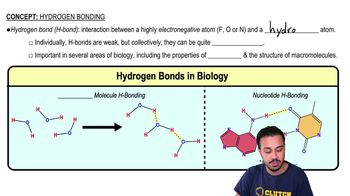
Hydrogen bonds are weak interactions that occur between a hydrogen atom covalently bonded to an electronegative atom (such as oxygen or nitrogen) and another electronegative atom nearby. These bonds are not as strong as covalent or ionic bonds but are crucial for molecular interactions.
In the body, hydrogen bonds play a key role in stabilizing the structure of biomolecules, such as DNA and proteins. For example, in DNA, hydrogen bonds between complementary base pairs (adenine-thymine and cytosine-guanine) help maintain the double helix structure.
Hydrogen bonds are also essential in protein folding. They help stabilize secondary structures like alpha helices and beta sheets, which are critical for the protein's function.
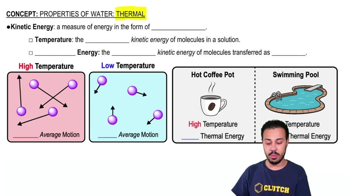
Hydrogen bonds contribute to the unique properties of water, such as its high heat capacity and surface tension. These properties are vital for maintaining homeostasis and facilitating biochemical reactions in the body.
In cellular processes, hydrogen bonds enable enzyme-substrate interactions and receptor-ligand binding, ensuring proper biochemical signaling and metabolic activity.
Verified video answer for a similar problem:
This video solution was recommended by our tutors as helpful for the problem above
Video duration:
1m
Play a video:
Was this helpful?
Key Concepts
Here are the essential concepts you must grasp in order to answer the question correctly.
Hydrogen Bonds
Hydrogen bonds are weak attractions that occur between a hydrogen atom covalently bonded to an electronegative atom and another electronegative atom. These bonds are crucial in determining the structure and properties of water, proteins, and nucleic acids, influencing how molecules interact and function within biological systems.
Hydrogen bonds significantly contribute to the unique properties of water, such as its high surface tension, specific heat, and solvent capabilities. These properties are vital for maintaining homeostasis in living organisms, facilitating biochemical reactions, and supporting cellular structures.
In biological systems, hydrogen bonds play a critical role in stabilizing the three-dimensional structures of proteins and nucleic acids. They are essential for processes like DNA replication and protein folding, ensuring that biological molecules maintain their functional shapes and perform their roles effectively.