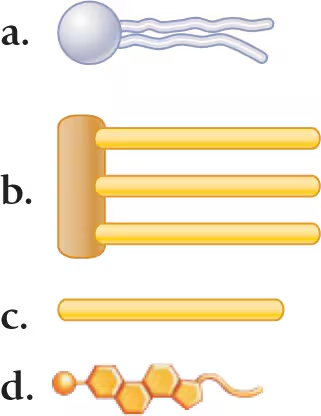
Which of the following forms the basic structure of cell membranes? Which is the basis for producing sex hormones?
Verified step by step guidance
1
Step 1: Understand the basic structure of cell membranes. Cell membranes are primarily composed of a phospholipid bilayer, which consists of hydrophilic (water-attracting) heads and hydrophobic (water-repelling) tails. This structure allows the membrane to be selectively permeable.
Step 2: Recognize the role of lipids in the production of sex hormones. Sex hormones, such as testosterone and estrogen, are derived from cholesterol, which is a type of lipid. Cholesterol serves as the precursor molecule for steroid hormone synthesis.
Step 3: Analyze the options provided in the question. Look for visual or textual clues in the image and options (a, b, c, d) to identify which structure corresponds to phospholipids (for cell membranes) and cholesterol (for sex hormone production).
Step 4: Match the structural features of the molecules in the image to their functions. For example, phospholipids will have a dual-layer structure with hydrophilic heads and hydrophobic tails, while cholesterol will have a characteristic ring structure.
Step 5: Select the correct options based on your analysis. Ensure that the option corresponding to the phospholipid bilayer is chosen for the cell membrane structure and the option corresponding to cholesterol is chosen for the basis of sex hormone production.
Verified video answer for a similar problem:
This video solution was recommended by our tutors as helpful for the problem above
Video duration:
1m
Play a video:
Was this helpful?
Key Concepts
Here are the essential concepts you must grasp in order to answer the question correctly.
Phospholipid Bilayer
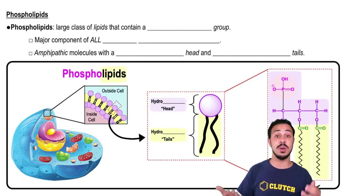
The phospholipid bilayer is the fundamental structure of cell membranes, composed of two layers of phospholipids. Each phospholipid molecule has a hydrophilic (water-attracting) 'head' and two hydrophobic (water-repelling) 'tails.' This arrangement allows the membrane to be selectively permeable, facilitating the movement of substances in and out of the cell while maintaining its integrity.
Steroid hormones are a class of hormones derived from cholesterol, which serve as signaling molecules in the body. They include sex hormones such as estrogen and testosterone, which are crucial for reproductive functions and secondary sexual characteristics. The structure of steroid hormones allows them to easily pass through cell membranes and bind to specific receptors, influencing gene expression and cellular activity.
Cell membranes serve multiple essential functions, including protecting the cell's interior, facilitating communication with other cells, and regulating the transport of substances. They contain various proteins that act as receptors, channels, and transporters, enabling the cell to respond to external signals and maintain homeostasis. Understanding these functions is vital for grasping how cells interact with their environment.