Multiple Choice
The water molecule is a permanent electric dipole with a dipole moment of . A water molecule is aligned with an electric field of magnitude . How much energy is required to rotate the molecule 180°?
1575
views
 Back
BackTwo small charged spheres are 5.0 cm apart. One is charged to +25 nC, the other to −15 nC. A proton is released from rest halfway between the spheres. What is the proton's speed after it has moved 1.0 cm?
Two 10-cm-diameter electrodes 0.50 cm apart form a parallel-plate capacitor. The electrodes are attached by metal wires to the terminals of a 15 V battery. After a long time, the capacitor is disconnected from the battery but is not discharged. What are the charge on each electrode, the electric field strength inside the capacitor, and the potential difference between the electrodes after the original electrodes (not the modified electrodes of part b) are expanded until they are 20 cm in diameter?
An electric dipole consists of 1.0 g spheres charged to ±2.0 nC at the ends of a 10-cm-long massless rod. The dipole rotates on a frictionless pivot at its center. The dipole is held perpendicular to a uniform electric field with field strength 1000 V/m, then released. What is the dipole's angular velocity at the instant it is aligned with the electric field?
A 250 pg dust particle has charge −250e. Its speed is 2.0 m/s at point 1, where the electric potential is V₁=2000 V. What speed will it have at point 2, where the potential is V₂=−5000 V? Ignore air resistance and gravity.
A 0.25 pg dust particle with 50 excess electrons is sitting at rest on top of a 5.0-cm-diameter metal sphere. Closing a switch charges the sphere almost instantaneously. To what potential must the sphere be charged to launch the dust particle to a height of 5.0 m? Ignore air resistance.
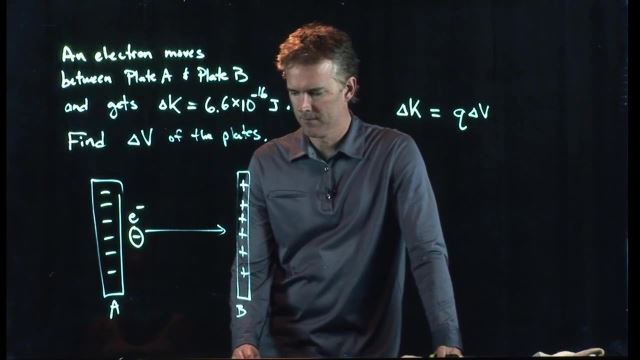
The electron gun in an old TV picture tube accelerates electrons between two parallel plates 1.2 cm apart with a 25 kV potential difference between them. The electrons enter through a small hole in the negative plate, accelerate, then exit through a small hole in the positive plate. Assume that the holes are small enough not to affect the electric field or potential. With what speed does an electron exit the electron gun if its entry speed is close to zero?
An electron with an initial speed of 500,000 m/s is brought to rest by an electric field. Did the electron move into a region of higher potential or lower potential?
During an action potential, Na⁺ ions move into the cell at a rate of about 3 x 10⁻⁷ mol/m2s. How much power must be produced by the “active Na⁺ pumping” system to produce this flow against a +30-mV potential difference? Assume that the axon is 10 cm long and 20 μm in diameter.
 09:11
09:11