Join thousands of students who trust us to help them ace their exams!
Multiple Choice
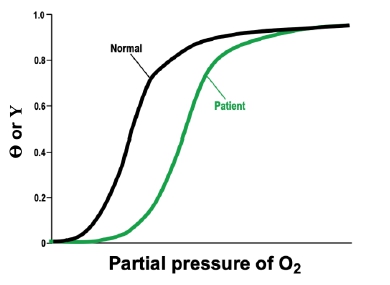
A 9-month old girl with hemolytic anemia is found to have a deficiency in the enzyme responsible for the conversion of molecule-B to pyruvate. Shown below is the oxygen saturation curve for hemoglobin in the erythrocytes of this patient (green curve), compared to the corresponding black curve in normal red blood cells. Which of the following is the most likely explanation for the observed oxygen saturation curve in this patient?
A
Decreased [BPG].
B
Increased [BPG].
C
Decreased blood glucose.
D
Increased blood glucose.
2 Comments
Verified step by step guidance
1
Identify the enzyme deficiency: The problem states a deficiency in the enzyme responsible for converting molecule-B to pyruvate. This suggests a deficiency in the glycolytic pathway, specifically pyruvate kinase, which catalyzes the conversion of phosphoenolpyruvate (PEP) to pyruvate.
Understand the role of 2,3-Bisphosphoglycerate (BPG): BPG is a byproduct of glycolysis and plays a crucial role in regulating oxygen binding to hemoglobin. It decreases hemoglobin's affinity for oxygen, facilitating oxygen release to tissues.
Analyze the oxygen saturation curve: The green curve (patient) is shifted to the right compared to the black curve (normal). A rightward shift indicates decreased oxygen affinity, meaning hemoglobin releases oxygen more readily.
Correlate enzyme deficiency with BPG levels: Pyruvate kinase deficiency leads to an accumulation of glycolytic intermediates, including 1,3-bisphosphoglycerate, which can be converted to 2,3-BPG. This results in increased BPG levels in red blood cells.
Conclude the effect of increased BPG: The increased BPG levels in the patient's erythrocytes cause the rightward shift in the oxygen saturation curve, explaining the observed curve in the patient. Therefore, the most likely explanation is increased [BPG].


 Verified step by step guidance

