9. Quantum Mechanics
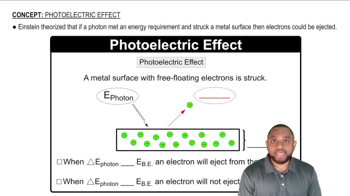
Photoelectric Effect
9. Quantum Mechanics
Photoelectric Effect
 02:31
02:31

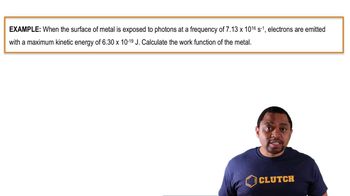
Showing 5 of 5 videos
Additional 4 creators.
Learn with other creators






Showing 7 of 7 videos
Practice this topic
- Multiple Choice
An ultraviolet photon with a wavelength of 320 nm strikes a metal surface. The emitted electron has a kinetic energy of 3.0 x 10⁻² eV. What is the binding energy of the electron in kJ/mol? 1 electron volt (eV) = 1.602 x 10⁻¹⁹ J.
2624views5rank2comments - Multiple ChoiceWhich best describes the photoelectric effect?1515views
- Multiple ChoiceWhich of the following is true about the photoelectric effect?1540views
- Open Question
What is the threshold frequency ν0 of cesium?
1069views - Open Question
What is the threshold frequency for sodium metal if a photon with frequency 6.66 × 10¹⁴ s−1 ejects an electron with 7.74 × 10⁻²⁰ J kinetic energy? Will the photoelectric effect be observed if sodium is exposed to orange light?
1199views - Open QuestionWhat is the threshold frequency ν0 of cesium2395views
- Multiple ChoiceWhen sunlight strikes a photovoltaic cell, which of the following occurs?101views