21. Nuclear Chemistry
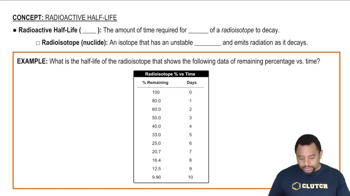
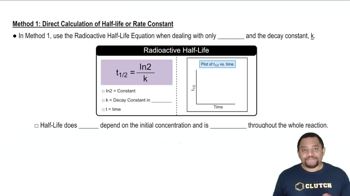
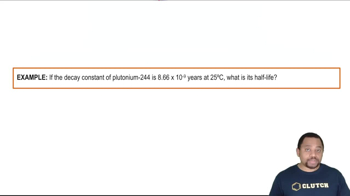
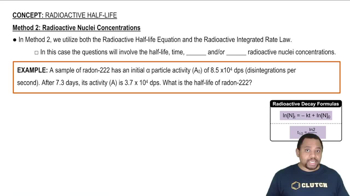
Radioactive Half-Life
 01:30
01:30

Practice this topic
- Multiple Choice
The half-life of arsenic-74 is about 18 days. If a sample initially contains 5.13 x 10⁴ mg arsenic-74, what mass (in mg) would be left after 80 days?
1045views1rank - Multiple Choice
What percentage of carbon – 14 ( t1/2 = 5715 years) remains in a sample estimated to be 18,315 years old?
1135views1rank - Open Question
What fraction of a reactant has been consumed after 4 half-lives in a first-order reaction?
1002views - Open Question
A fossil is found to have a 14C level of 76.0% compared to living organisms. How old is the fossil?
1040views - Open Question
A moon rock collected by the Apollo mission is estimated to be 3.80 billion years old by uranium/lead dating. Assuming that the rock did not contain any lead when it was formed, what is the current mass of 206 Pb in the rock, given that it currently contains 1.180 g of 238 u? The half-life of 238U is 4.47×10⁹ years.
1966views - Multiple ChoiceA 2.00 mg sample of the radioisotope phosphorus-32 is found to contain 0.400 mg of phosphorus-32 after 33.3 days. Calculate the half-life (in days).817views
- Multiple ChoiceCarbon-14, which is present in all living tissue, radioactively decays via a first-order process. A one-gram sample of wood taken from a living tree gives a rate for carbon-14 decay of 13.6 counts per minute (CPM). If the half-life for carbon-14 is 5720 years, calculate the time it would take for the count rate to decrease to 6.8 CPM.909views