Table of contents
- 1. Intro to General Chemistry
- Classification of Matter
- Physical & Chemical Changes
- Chemical Properties
- Physical Properties
- Intensive vs. Extensive Properties
- Temperature
- Scientific Notation
- SI Units
- Metric Prefixes
- Significant Figures
- Significant Figures: Precision in Measurements
- Significant Figures: In Calculations
- Conversion Factors
- Dimensional Analysis
- Density
- Density of Geometric Objects
- Density of Non-Geometric Objects
- 2. Atoms & Elements
- The Atom
- Subatomic Particles
- Isotopes
- Ions
- Atomic Mass
- Periodic Table: Classifications
- Periodic Table: Group Names
- Periodic Table: Representative Elements & Transition Metals
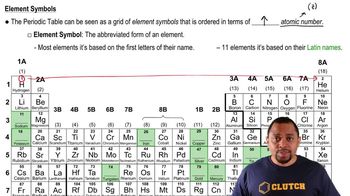
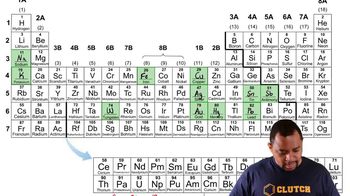
- Periodic Table: Element Symbols
- Periodic Table: Elemental Forms
- Periodic Table: Phases
- Periodic Table: Charges
- Calculating Molar Mass
- Mole Concept
- Law of Conservation of Mass
- Law of Definite Proportions
- Atomic Theory
- Law of Multiple Proportions
- Millikan Oil Drop Experiment
- Rutherford Gold Foil Experiment
- 3. Chemical Reactions
- Empirical Formula
- Molecular Formula
- Combustion Analysis
- Combustion Apparatus
- Polyatomic Ions
- Naming Ionic Compounds
- Writing Ionic Compounds
- Naming Ionic Hydrates
- Naming Acids
- Naming Molecular Compounds
- Balancing Chemical Equations
- Stoichiometry
- Limiting Reagent
- Percent Yield
- Mass Percent
- Functional Groups in Chemistry
- 4. BONUS: Lab Techniques and Procedures
- 5. BONUS: Mathematical Operations and Functions
- 6. Chemical Quantities & Aqueous Reactions
- 7. Gases
- Pressure Units
- The Ideal Gas Law
- The Ideal Gas Law Derivations
- The Ideal Gas Law Applications
- Chemistry Gas Laws
- Chemistry Gas Laws: Combined Gas Law
- Mole Fraction of Gases
- Partial Pressure
- The Ideal Gas Law: Molar Mass
- The Ideal Gas Law: Density
- Gas Stoichiometry
- Standard Temperature and Pressure
- Effusion
- Root Mean Square Speed
- Kinetic Energy of Gases
- Maxwell-Boltzmann Distribution
- Velocity Distributions
- Kinetic Molecular Theory
- Van der Waals Equation
- 8. Thermochemistry
- 9. Quantum Mechanics
- Wavelength and Frequency
- Speed of Light
- The Energy of Light
- Electromagnetic Spectrum
- Photoelectric Effect
- De Broglie Wavelength
- Heisenberg Uncertainty Principle
- Bohr Model
- Emission Spectrum
- Bohr Equation
- Introduction to Quantum Mechanics
- Quantum Numbers: Principal Quantum Number
- Quantum Numbers: Angular Momentum Quantum Number
- Quantum Numbers: Magnetic Quantum Number
- Quantum Numbers: Spin Quantum Number
- Quantum Numbers: Number of Electrons
- Quantum Numbers: Nodes
- 10. Periodic Properties of the Elements
- The Electron Configuration
- The Electron Configuration: Condensed
- The Electron Configurations: Exceptions
- The Electron Configuration: Ions
- Paramagnetism and Diamagnetism
- The Electron Configuration: Quantum Numbers
- Valence Electrons of Elements
- Periodic Trend: Metallic Character
- Periodic Trend: Atomic Radius
- Periodic Trend: Ionic Radius
- Periodic Trend: Ionization Energy
- Periodic Trend: Successive Ionization Energies
- Periodic Trend: Electron Affinity
- Periodic Trend: Electronegativity
- Periodic Trend: Effective Nuclear Charge
- Periodic Trend: Cumulative
- 11. Bonding & Molecular Structure
- Lewis Dot Symbols
- Chemical Bonds
- Dipole Moment
- Octet Rule
- Formal Charge
- Lewis Dot Structures: Neutral Compounds
- Lewis Dot Structures: Sigma & Pi Bonds
- Lewis Dot Structures: Ions
- Lewis Dot Structures: Exceptions
- Lewis Dot Structures: Acids
- Resonance Structures
- Average Bond Order
- Bond Energy
- Coulomb's Law
- Lattice Energy
- Born Haber Cycle
- 12. Molecular Shapes & Valence Bond Theory
- 13. Liquids, Solids & Intermolecular Forces
- 14. Solutions
- Solutions: Solubility and Intermolecular Forces
- Molality
- Parts per Million (ppm)
- Mole Fraction of Solutions
- Solutions: Mass Percent
- Types of Aqueous Solutions
- Intro to Henry's Law
- Henry's Law Calculations
- The Colligative Properties
- Boiling Point Elevation
- Freezing Point Depression
- Osmosis
- Osmotic Pressure
- Vapor Pressure Lowering (Raoult's Law)
- 15. Chemical Kinetics
- 16. Chemical Equilibrium
- 17. Acid and Base Equilibrium
- Acids Introduction
- Bases Introduction
- Binary Acids
- Oxyacids
- Bases
- Amphoteric Species
- Arrhenius Acids and Bases
- Bronsted-Lowry Acids and Bases
- Lewis Acids and Bases
- The pH Scale
- Auto-Ionization
- Ka and Kb
- pH of Strong Acids and Bases
- Ionic Salts
- pH of Weak Acids
- pH of Weak Bases
- Diprotic Acids and Bases
- Diprotic Acids and Bases Calculations
- Triprotic Acids and Bases
- Triprotic Acids and Bases Calculations
- 18. Aqueous Equilibrium
- Intro to Buffers
- Henderson-Hasselbalch Equation
- Intro to Acid-Base Titration Curves
- Strong Titrate-Strong Titrant Curves
- Weak Titrate-Strong Titrant Curves
- Acid-Base Indicators
- Titrations: Weak Acid-Strong Base
- Titrations: Weak Base-Strong Acid
- Titrations: Strong Acid-Strong Base
- Titrations: Diprotic & Polyprotic Buffers
- Solubility Product Constant: Ksp
- Ksp: Common Ion Effect
- Precipitation: Ksp vs Q
- Selective Precipitation
- Complex Ions: Formation Constant
- 19. Chemical Thermodynamics
- 20. Electrochemistry
- 21. Nuclear Chemistry
- Intro to Radioactivity
- Alpha Decay
- Beta Decay
- Gamma Emission
- Electron Capture & Positron Emission
- Neutron to Proton Ratio
- Band of Stability: Alpha Decay & Nuclear Fission
- Band of Stability: Beta Decay
- Band of Stability: Electron Capture & Positron Emission
- Band of Stability: Overview
- Measuring Radioactivity
- Rate of Radioactive Decay
- Radioactive Half-Life
- Mass Defect
- Nuclear Binding Energy
- 22. Organic Chemistry
- Introduction to Organic Chemistry
- Structural Formula
- Condensed Formula
- Skeletal Formula
- Spatial Orientation of Bonds
- Intro to Hydrocarbons
- Isomers
- Chirality
- Functional Groups in Chemistry
- Naming Alkanes
- The Alkyl Groups
- Naming Alkanes with Substituents
- Naming Cyclic Alkanes
- Naming Other Substituents
- Naming Alcohols
- Naming Alkenes
- Naming Alkynes
- Naming Ketones
- Naming Aldehydes
- Naming Carboxylic Acids
- Naming Esters
- Naming Ethers
- Naming Amines
- Naming Benzene
- Alkane Reactions
- Intro to Addition Reactions
- Halogenation Reactions
- Hydrogenation Reactions
- Hydrohalogenation Reactions
- Alcohol Reactions: Substitution Reactions
- Alcohol Reactions: Dehydration Reactions
- Intro to Redox Reactions
- Alcohol Reactions: Oxidation Reactions
- Aldehydes and Ketones Reactions
- Ester Reactions: Esterification
- Ester Reactions: Saponification
- Carboxylic Acid Reactions
- Amine Reactions
- Amide Formation
- Benzene Reactions
- 23. Chemistry of the Nonmetals
- Main Group Elements: Bonding Types
- Main Group Elements: Boiling & Melting Points
- Main Group Elements: Density
- Main Group Elements: Periodic Trends
- The Electron Configuration Review
- Periodic Table Charges Review
- Hydrogen Isotopes
- Hydrogen Compounds
- Production of Hydrogen
- Group 1A and 2A Reactions
- Boron Family Reactions
- Boron Family: Borane
- Borane Reactions
- Nitrogen Family Reactions
- Oxides, Peroxides, and Superoxides
- Oxide Reactions
- Peroxide and Superoxide Reactions
- Noble Gas Compounds
- 24. Transition Metals and Coordination Compounds
- Atomic Radius & Density of Transition Metals
- Electron Configurations of Transition Metals
- Electron Configurations of Transition Metals: Exceptions
- Paramagnetism and Diamagnetism
- Ligands
- Complex Ions
- Coordination Complexes
- Classification of Ligands
- Coordination Numbers & Geometry
- Naming Coordination Compounds
- Writing Formulas of Coordination Compounds
- Isomerism in Coordination Complexes
- Orientations of D Orbitals
- Intro to Crystal Field Theory
- Crystal Field Theory: Octahedral Complexes
- Crystal Field Theory: Tetrahedral Complexes
- Crystal Field Theory: Square Planar Complexes
- Crystal Field Theory Summary
- Magnetic Properties of Complex Ions
- Strong-Field vs Weak-Field Ligands
- Magnetic Properties of Complex Ions: Octahedral Complexes
2. Atoms & Elements
Periodic Table: Element Symbols
2. Atoms & Elements
Periodic Table: Element Symbols
 04:01
04:01

Learn with other creators


Practice this topic
- Open Question
What is the significance of the periodic table of elements? Choose the best answer.
1058views - Open Question
Which element is placed in the same period as ruthenium but has a higher atomic number than it?
886views - Open Question
The symbol for xenon (Xe) would be a part of the noble gas notation for the element.
860views - Open Question
What is the atomic symbol for the element in group 4B (4) and the fourth period?
865views - Multiple ChoiceIn the context of atomic structure, what do the letters 'CEU' stand for?566views
- Multiple ChoiceWhat is the symbol for the element with 3 protons?574views
- Multiple ChoiceWhich of the following elements is necessary for the production of thyroid hormone?609views
- Multiple ChoiceWhich property is unique for each element on the periodic table?29views