3. Chemical Reactions
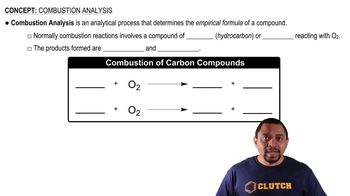
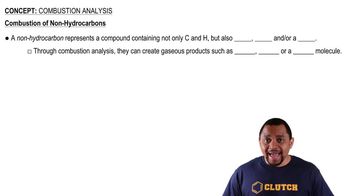
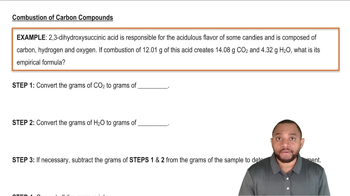
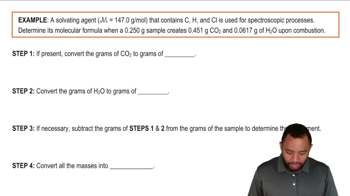
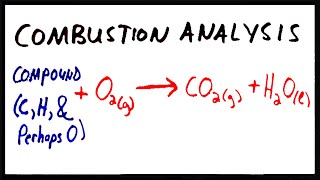
Combustion Analysis
 02:09
02:09

Learn with other creators




Practice this topic
- Open Question
The combustion of 4.16 grams of a compound which contains only C,H,O and F yields 7.7 g CO2 and 2.52 g H2O. Another sample of the compound with a mass of 3.63 g is found to contain 0.58 g F. What is the empirical formula of the compound?
2481views25rank4comments - Multiple ChoiceWhen the following equation is balanced
C5H10(l) + O2(g) → CO2(g) + H2O(g)
What is the coefficient for carbon dioxide?1571views - Multiple Choice
A compound composed of carbon, hydrogen and nitrogen undergoes a combustion reaction to produce 264.21 g CO2, 63.06 g H2O and 46.4 g NO2. Determine its empirical formula.
1885views11rank1comments - Multiple Choice
In the presence of a small amount of oxygen a combustion reaction will not only produce carbon dioxide, but also carbon monoxide. The incomplete combustion of naphthalene, a hydrocarbon used in many dyes, produced 2.80 g CO, 4.40 g CO2 and 1.44 g H2O. Determine its empirical formula.
1299views9rank1comments - Open Question
Which clue can be used to identify a chemical reaction as a combustion reaction? Oxygen is a product. A hydrocarbon reacts with oxygen. Water and carbon dioxide react. The reaction involves ions.
1193views - Open QuestionCombustion analysis of 63.8 mg of a c h and o1290views
- Open Question
Which clue can be used to identify a chemical reaction as a combustion reaction?
1058views - Multiple ChoiceWhat is the standard enthalpy change for the combustion of one mole of benzene (C6H6) based on the given reaction: 2 C6H6(l) + 15 O2(g) → 12 CO2(g) + 6 H2O(l); ΔHrxn° = -6534 kJ?776views