3. Chemical Reactions
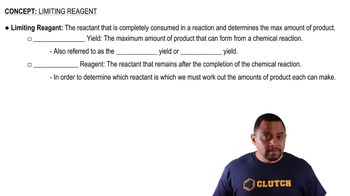
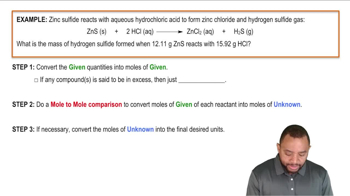
Limiting Reagent
3. Chemical Reactions
Limiting Reagent
 01:30
01:30

Additional 3 creators.
Learn with other creators






Showing 6 of 6 videos
Practice this topic
- Multiple ChoiceWhen the amounts of all reactants are given for a chemical equation, the amount that is used to calculate the amount of product formed is the1167views1rank
- Multiple Choice
Lithium solid reacts with oxygen gas to create lithium oxide solid.
4 Li (s) + O2 (g) → 2 Li2O (s)
If 131 g of Li are allowed to react with 215 g O2, how many kilograms of the excess reactant would remain?
1900views11rank3comments - Open Question
Nitrogen and hydrogen combine at a high temperature, in the presence of a catalyst, to produce ammonia. N2(g) + 3H2(g) ⟶ 2NH3(g) there are four molecules of nitrogen and nine molecules of hydrogen present in the diagram. When the reaction is complete, how many molecules of NH3 are produced?
1402views - Open QuestionAfter the reaction, how much octane is left?1315views
- Open QuestionHow many moles of water are produced in this reaction?1203views
- Open QuestionFor each of the given situations, indicate whether s or o2 is the limiting reactant.1653views
- Multiple ChoiceIf you have 24 grams of magnesium (Mg) and 16 grams of oxygen (O₂), which is the limiting reactant in the reaction 2Mg + O₂ → 2MgO?935views
- Multiple ChoiceSuppose 0.0350 g Mg is reacted with 10.00 mL of 6 M HCl to produce aqueous magnesium chloride and hydrogen gas. Mg(s) + 2HCl(aq) → MgCl2(aq) + H2(g). What is the limiting reactant in this reaction?823views