13. Liquids, Solids & Intermolecular Forces
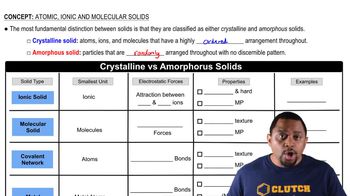
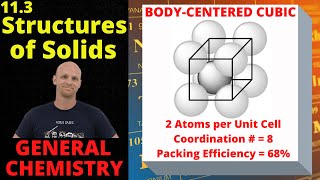
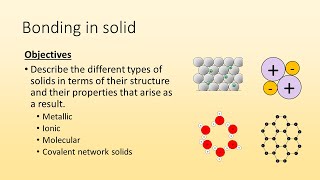
Atomic, Ionic, and Molecular Solids
13. Liquids, Solids & Intermolecular Forces
Atomic, Ionic, and Molecular Solids
 04:13
04:13

Additional 2 creators.
Learn with other creators





Showing 5 of 5 videos
Practice this topic
- Multiple Choice
What is the major electrostatic force found between ammonia molecules, NH3?
1985views3rank2comments - Multiple Choice
As it cools off, olive oil slowly hardens and forms a solid over a range of temperatures. Which best describes it as a solid?
1779views8rank2comments - Multiple Choice
Compound A is hard, doesn't conduct electricity, and melts at 1400ºC. Compound A represents which of the following:
1548views8rank1comments - Multiple ChoiceWhich of the following statements is true?967views
- Open Question
Which statement best describes why carbon can form a wide variety of organic compounds?
830views - Open Question
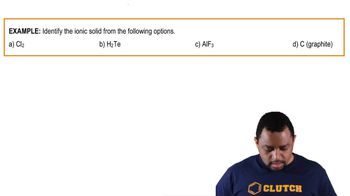
Consider the compound Al(OH)3. What type of solid does it form? Crystal lattice, glass, metal, or molecule?
961views - Open Question
What type of crystalline solid is CH3CH2CH2CH3?
1156views - Open QuestionAll of the following describes ionic compounds except1031views