13. Liquids, Solids & Intermolecular Forces
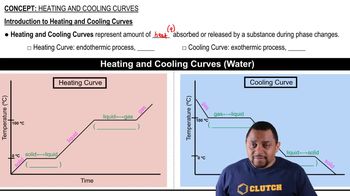
Heating and Cooling Curves
13. Liquids, Solids & Intermolecular Forces
Heating and Cooling Curves
 03:52
03:52

Additional 1 creators.
Learn with other creators




Practice this topic
- Multiple Choice
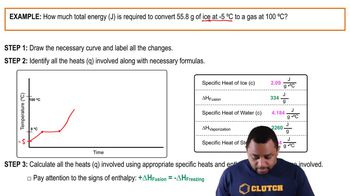
How much energy (kJ) is required to convert a 76.4 g acetone (MM = 58.08 g/mol) as a liquid at -30°C to a solid at -115.0°C?
2066views5comments - Multiple Choice
If 53.2kJ of heat are added to a 15.5g ice cube at - 5.00 oC, what will be the resulting state and temperature of the substance?
4135views9rank7comments - Multiple ChoiceCalculate the volume (mL) of acetone, C3 H6 O, (density = 0.786 g/mL) that can be vaporized at its normal boiling point with 345 kJ of heat. ΔHvap for acetone is 29.1 kJ/mol.1304views
- Open Question
What quantity of heat, in kj, is required to convert 50.0 g of ethanol (C₂H₅OH) at 23.0°C to a vapor at 78.3°C (its boiling point)? (specific heat capacity of ethanol = 2.46 J/g • c; ∆Hvap = 39.3 kJ/mol)
1100views - Open Question
Which is the process by which a gas changes to a solid: deposition, evaporation, freezing, or sublimation?
639views - Open Question
What are greenhouse gases? How does carbon dioxide enter the atmosphere? (Site 1)
640views - Open Question
If the heating curve is reversed, what would best describe the boiling point?
666views - Multiple ChoiceWhich of the following does NOT represent a step on the heating curve of water?149views1rank