Join thousands of students who trust us to help them ace their exams!
Multiple Choice
If 53.2kJ of heat are added to a 15.5 g ice cube at - 5.00 oC, what will be the resulting state and temperature of the substance?
A
322.5°C, gas
B
-3.70ºC, solid
C
98.82 ºC, liquid
D
222.5 ºC, gas
7 Comments
Verified step by step guidance
1
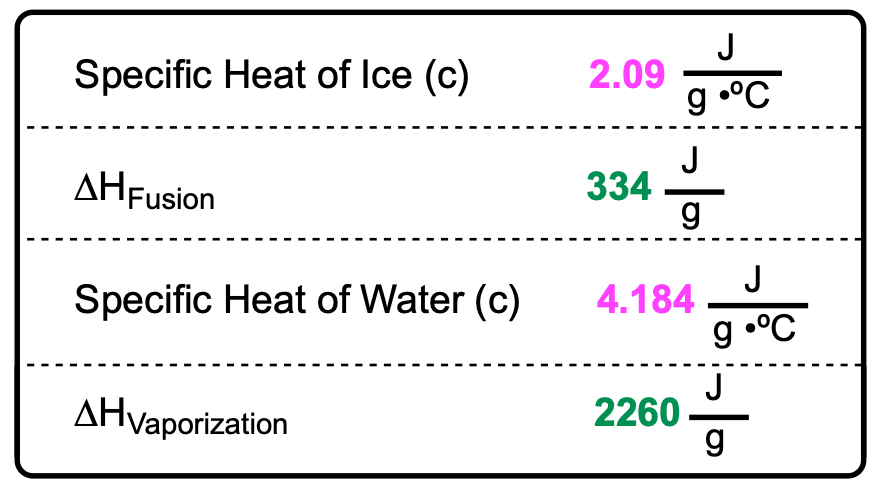
Step 1: Calculate the energy required to raise the temperature of the ice from -5.00°C to 0°C using the formula \(q = m \times c \times \Delta T\), where \(m\) is the mass, \(c\) is the specific heat of ice, and \(\Delta T\) is the temperature change.
Step 2: Determine if the added heat (53.2 kJ) is enough to raise the temperature of the ice to 0°C by comparing the heat calculated in Step 1 with the given heat. If not, calculate the final temperature by rearranging the formula to \(\Delta T = \frac{q}{m \times c}\).
Step 3: If there is leftover heat after warming the ice to 0°C, calculate the energy required to melt the ice completely using \(q = m \times \Delta H_{Fusion}\), where \(\Delta H_{Fusion}\) is the enthalpy of fusion.
Step 4: If heat remains after melting the ice, calculate the energy required to raise the temperature of the resulting water from 0°C to 100°C using \(q = m \times c \times \Delta T\), where \(c\) is the specific heat of water.
Step 5: If there is still heat left after heating the water to 100°C, calculate the energy required to vaporize the water using \(q = m \times \Delta H_{Vaporization}\). Determine the final state (solid, liquid, or gas) and temperature based on how much heat is used in each step.


 Verified step by step guidance

