14. Solutions
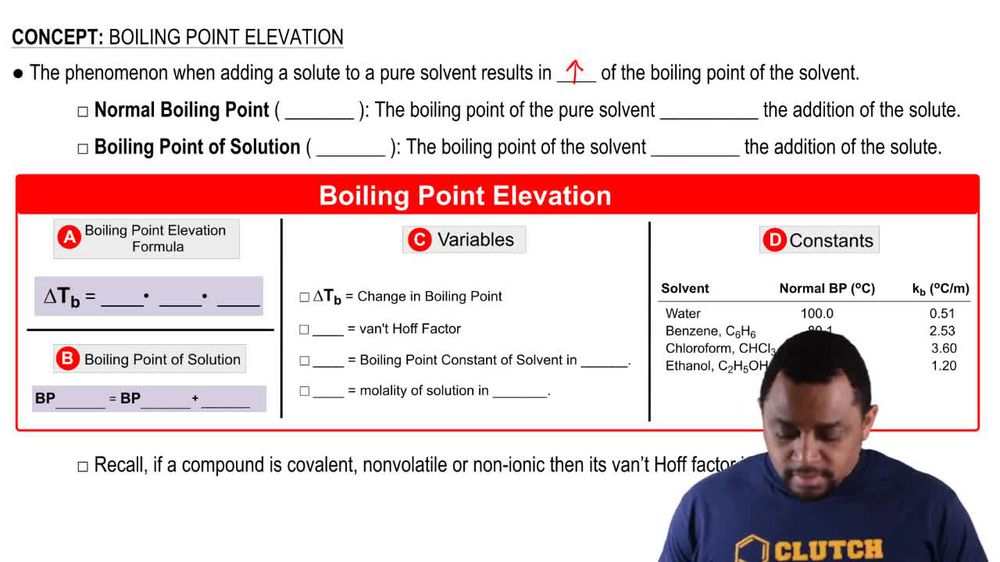
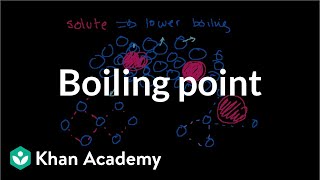
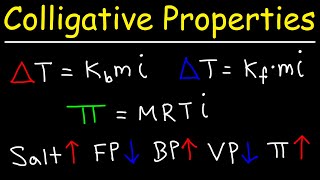
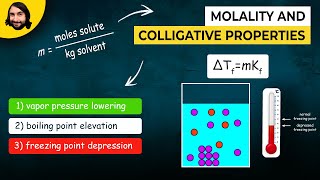
Boiling Point Elevation

 40:37
40:37








Practice this topic
- Multiple Choice
An ethylene glycol solution contains 25.2 g of ethylene glycol (C2H6O2) in 99.5 mL of water. Determine the change in boiling point. Assume a density of 1.00 g/mL for water.
2250views1comments - Multiple Choice
Pure water boils at 100°C. What is the new boiling point of water after the addition of 13.12 g aluminum chloride, AlCl3, to 615 g water?
2856views6rank - Multiple Choice
What is the molality of glucose in an aqueous solution if the boiling point of the solution is 103.15°C?
1918views - Multiple Choice
Carbon dioxide is dissolved in 722 mL of benzene with a density of 1.59 g/mL. What mass of carbon dioxide would you add to make the boiling point of the solution 104.7°C? (BP of benzene = 80.1 °C)
1661views4rank4comments - Textbook QuestionThe following phase diagram shows part of the liquid–vapor phase-transition boundaries for pure ether and a solution of a nonvolatile solute in ether. (b) What is the approximate mo#lal concentration of the sol-ute? [Kb for ether is 2.021°C kg2>mol.]449views
- Textbook Question
Adrenaline is the hormone that triggers the release of extra glucose molecules in times of stress or emergency. A solution of 0.64 g of adrenaline in 36.0 g of CCl4 elevates the boiling point by 0.49 °C. Calculate the approximate molar mass of adrenaline from this data.
844views - Textbook Question
A 1.2 m aqueous solution of an ionic compound with the formula MX2 has a boiling point of 101.4 °C. Calculate the van't Hoff factor (i) for MX2 at this concentration.
1528views - Textbook Question
Carbon disulfide (CS2) boils at 46.30 °C and has a density of 1.261 g/mL. (a) When 0.250 mol of a nondissociating solute is dissolved in 400.0 mL of CS2, the solution boils at 47.46 °C. What is the molal boiling-point-elevation constant for CS2?
1038views1rank