Assume you stain Clostridium by applying a basic stain, carbolfuchsin, with heat, decolorizing with acid-alcohol, and counterstaining with an acidic stain, nigrosin. Through the microscope, the endospores are 1, and the cells are stained 2. a. 1—red; 2—black b. 1—black; 2—colorless c. 1—colorless; 2—black d. 1—red; 2—colorless e. 1—black; 2—red
Verified step by step guidance
1
Step 1: Understand the staining procedure described. Carbolfuchsin is a basic stain used with heat, which is typically used in endospore staining to penetrate the tough spore coat and stain the endospores red.
Step 2: Recognize that acid-alcohol is used as a decolorizer. It will remove the carbolfuchsin stain from the vegetative cells but not from the endospores because of their resistant coat.
Step 3: Note that nigrosin is an acidic stain used as a counterstain. Acidic stains generally stain the background or cells that have been decolorized, often resulting in a dark or black color.
Step 4: Combine these facts: endospores retain the red carbolfuchsin stain after acid-alcohol treatment, while the vegetative cells lose the red stain and take up the black nigrosin counterstain.
Step 5: Conclude that under the microscope, the endospores will appear red and the cells will appear black, matching option (a).
Verified video answer for a similar problem:
This video solution was recommended by our tutors as helpful for the problem above
Video duration:
2m
Play a video:
Was this helpful?
Key Concepts
Here are the essential concepts you must grasp in order to answer the question correctly.
Endospore Staining Technique
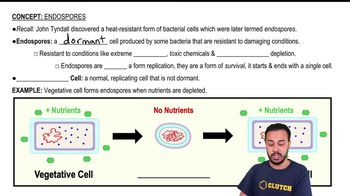
Endospore staining uses a primary stain like carbolfuchsin with heat to penetrate the tough spore coat. Heat acts as a mordant, allowing the stain to enter the endospore. After staining, decolorization removes the stain from vegetative cells but not from endospores, which retain the primary stain.
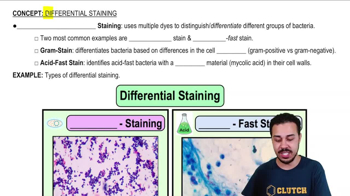
Decolorization with acid-alcohol selectively removes the primary stain from vegetative cells but not from endospores due to their resistant structure. This step differentiates endospores from the rest of the cell, making endospores retain the primary stain color while cells become colorless or take up the counterstain.
The counterstain, such as nigrosin (an acidic stain), stains the vegetative cells that lost the primary stain during decolorization. Nigrosin typically provides a contrasting color, allowing clear visualization of cells against the differently stained endospores under the microscope.