Eukaryotic flagella differ from prokaryotic flagella in that: a. Eukaryotic flagella use a rotary motion to propel the cell. b. Eukaryotic flagella are made of proteins. c. Eukaryotic flagella are not enclosed in a membrane. d. Eukaryotic flagella have a 9 +2 arrangement of microtubules.
Verified step by step guidance
1
Step 1: Understand the structural differences between eukaryotic and prokaryotic flagella. Eukaryotic flagella are complex organelles enclosed by the cell membrane, while prokaryotic flagella are simpler and not membrane-bound.
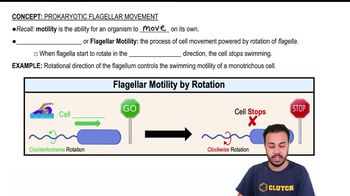
Step 2: Recall the motion mechanism. Prokaryotic flagella rotate like a propeller to move the cell, whereas eukaryotic flagella move with a whip-like or undulating motion.
Step 3: Consider the composition. Both types of flagella are made of proteins, but the specific proteins differ. Eukaryotic flagella are primarily composed of microtubules arranged in a characteristic pattern.
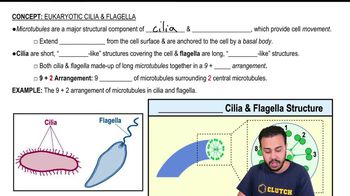
Step 4: Focus on the microtubule arrangement in eukaryotic flagella. They have a '9 + 2' arrangement, meaning nine pairs of microtubules form a ring around two central microtubules.
Step 5: Use this information to evaluate each option: (a) relates to motion type, (b) relates to composition, (c) relates to membrane presence, and (d) relates to microtubule structure. Identify which statement correctly describes eukaryotic flagella.
Verified video answer for a similar problem:
This video solution was recommended by our tutors as helpful for the problem above
Video duration:
1m
Play a video:
Was this helpful?
Key Concepts
Here are the essential concepts you must grasp in order to answer the question correctly.
Structure of Eukaryotic Flagella
Eukaryotic flagella are complex organelles composed of microtubules arranged in a characteristic 9 + 2 pattern, meaning nine pairs of microtubules surround two central microtubules. This structure is enclosed by the cell membrane and is essential for their whip-like motion.
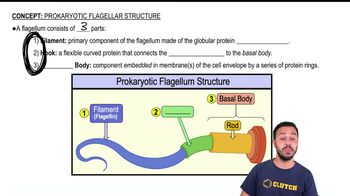
Prokaryotic flagella are simpler, made primarily of the protein flagellin, and lack microtubules. They are not enclosed by the cell membrane and function through a rotary motor mechanism embedded in the cell envelope, enabling a spinning motion to propel the cell.
Eukaryotic flagella move by bending in a whip-like fashion powered by dynein motor proteins sliding microtubules against each other. In contrast, prokaryotic flagella rotate like a propeller, driven by a rotary motor using proton motive force, resulting in different modes of cell propulsion.