In water, cations and anions of salts dissociate from one another and become surrounded by water molecules. In this state, the ions are also called __________ .
a. electrically negative b. ionically bonded c. electrolytes d. hydrogen bonds
Verified step by step guidance
1
Step 1: Understand the process of dissociation in water. When salts dissolve in water, they separate into their constituent ions, which are cations (positively charged) and anions (negatively charged).
Step 2: Recognize the role of water molecules. Water is a polar solvent, meaning it has a partial positive charge on one side and a partial negative charge on the other. This allows water molecules to surround and stabilize the ions.
Step 3: Identify the term used for ions in solution. When ions are surrounded by water molecules, they are in a state that allows them to conduct electricity.
Step 4: Consider the options provided. The term that describes ions in solution, which are capable of conducting electricity, is often used in the context of solutions.
Step 5: Choose the correct term from the options. The term that best describes ions in solution, surrounded by water molecules and capable of conducting electricity, is 'electrolytes'.
Verified video answer for a similar problem:
This video solution was recommended by our tutors as helpful for the problem above
Video duration:
2m
Play a video:
Was this helpful?
Key Concepts
Here are the essential concepts you must grasp in order to answer the question correctly.
Dissociation of Salts
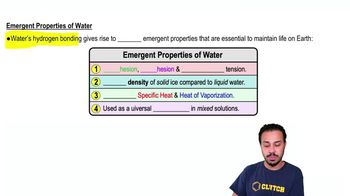
Dissociation refers to the process where ionic compounds, such as salts, separate into their constituent ions when dissolved in water. This occurs because the polar water molecules interact with the charged ions, effectively pulling them apart and allowing them to move freely in solution.
Electrolytes are substances that dissociate into ions when dissolved in water, enabling the solution to conduct electricity. Common examples include sodium chloride (table salt), which dissociates into sodium (Na+) and chloride (Cl-) ions, making the solution capable of conducting electrical current.
Ionic Bonds
Ionic bonds are the electrostatic forces of attraction between oppositely charged ions, formed when one atom donates an electron to another. In the context of salts, these bonds hold the ions together in a solid state, but they break when the salt is dissolved in water, leading to the formation of electrolytes.