a. uses auxotrophs and liver extract to reveal mutagens b. s time intensive and costly c. involves the isolation of a mutant by eliminating wild-type phenotypes with specific media d. proves that suspected chemicals are carcinogenic
Verified step by step guidance
1
Understand the purpose of the Ames test: It is a biological assay to assess the mutagenic potential of chemical compounds.
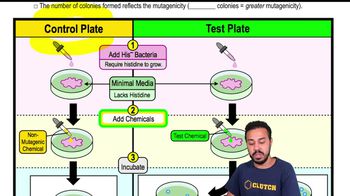
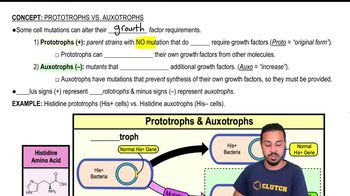
Recognize that the test uses specific strains of bacteria (often Salmonella typhimurium) that are auxotrophic, meaning they require a specific nutrient that they cannot synthesize due to a mutation.
Note that the test involves exposing these bacteria to the chemical being tested, along with a liver extract, which simulates the metabolic processes that occur in a living organism.
Observe that if the chemical causes mutations, some bacteria will revert to being able to synthesize the nutrient, allowing them to grow on a medium lacking that nutrient.
Conclude that the Ames test is primarily used to identify potential mutagens, which may indicate carcinogenic properties, but it does not directly prove carcinogenicity.
Verified video answer for a similar problem:
This video solution was recommended by our tutors as helpful for the problem above
Video duration:
2m
Play a video:
Was this helpful?
Key Concepts
Here are the essential concepts you must grasp in order to answer the question correctly.
Ames Test
The Ames test is a widely used assay that evaluates the mutagenic potential of chemical compounds. It employs strains of bacteria, often auxotrophs, which require specific nutrients to grow. When exposed to potential mutagens, any induced mutations that restore the bacteria's ability to grow indicate the presence of mutagenic properties in the tested substance.
Auxotrophs are mutant strains of microorganisms that lack the ability to synthesize a particular compound required for their growth. In the context of the Ames test, these auxotrophs are used to detect mutations that can reverse their nutritional deficiency, allowing them to grow on minimal media. This characteristic is crucial for identifying mutagens, as successful growth indicates a mutation has occurred.
Mutagenesis refers to the process by which the genetic information of an organism is changed, resulting in mutations. In the Ames test, the focus is on identifying substances that can cause such genetic changes, which may lead to cancer. While the Ames test can indicate mutagenic potential, it does not directly prove that a substance is carcinogenic, as further testing is required to establish a causal relationship.