The trp operon is repressible. This means it is usually __________ and is directly controlled by a(n) ___________ . a. active / inducer b. active / repressor c. inactive / inducer d. inactive /repressor
Verified step by step guidance
1
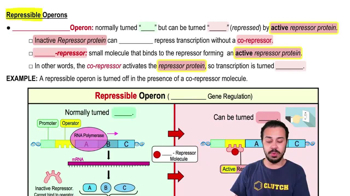
Understand the nature of a repressible operon: A repressible operon is typically 'on' or active under normal conditions, meaning the genes are being expressed to produce their products.
Recall that the trp operon controls the synthesis of tryptophan, an amino acid, and it is turned off when tryptophan is abundant.
Identify the regulatory molecule involved: In a repressible operon like the trp operon, a repressor protein is produced in an inactive form and becomes active only when it binds to a corepressor (in this case, tryptophan).
Recognize that the active repressor then binds to the operator region of the operon to block transcription, effectively turning the operon off.
Conclude that the trp operon is usually active and is directly controlled by a repressor protein, making the correct description: 'active / repressor'.
Verified video answer for a similar problem:
This video solution was recommended by our tutors as helpful for the problem above
Video duration:
2m
Play a video:
Was this helpful?
Key Concepts
Here are the essential concepts you must grasp in order to answer the question correctly.
Repressible Operon
A repressible operon is typically active under normal conditions, allowing gene expression. It can be turned off (repressed) when a specific molecule, often the end product of the pathway, is present in sufficient amounts, signaling that the genes are no longer needed.
In a repressible operon, a repressor protein is produced in an inactive form and cannot bind to the operator alone. When the corepressor molecule binds to the repressor, it activates the repressor, enabling it to bind the operator and block transcription.
Corepressors are small molecules that activate repressors to inhibit gene expression in repressible operons. Inducers, in contrast, deactivate repressors or activate activators to initiate transcription in inducible operons, highlighting different regulatory mechanisms.