Which of the following is/are true regarding proteins? Select all that apply. a. Proteins are made of amino acids. b. Proteins can have higher-order structure. c. Proteins are made by hydrolysis reactions. d. Peptides are large proteins. e. A protein's secondary structure is independent of the primary structure. f. If the protein's primary structure is altered, it will not impact the protein's tertiary structure.
Verified step by step guidance
1
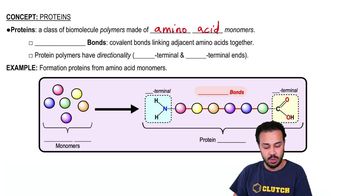
Step 1: Understand the basic composition of proteins. Proteins are polymers made up of monomers called amino acids, linked together by peptide bonds formed through dehydration synthesis (not hydrolysis). This confirms that statement (a) is true and statement (c) is false because proteins are not made by hydrolysis reactions, but rather broken down by them.
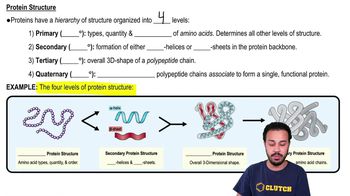
Step 2: Recognize the levels of protein structure. Proteins have multiple levels of structure: primary (sequence of amino acids), secondary (local folding like alpha-helices and beta-sheets), tertiary (3D folding of the entire polypeptide), and sometimes quaternary (assembly of multiple polypeptides). This means statement (b) is true because proteins can have higher-order structures beyond the primary sequence.
Step 3: Clarify the definition of peptides versus proteins. Peptides are short chains of amino acids, while proteins are longer, more complex chains. Therefore, statement (d) is false because peptides are not large proteins; they are smaller fragments.
Step 4: Understand the relationship between primary and secondary structure. The secondary structure depends on the primary sequence because the specific amino acid sequence determines how the chain folds locally. Hence, statement (e) is false since secondary structure is not independent of primary structure.
Step 5: Consider the impact of changes in primary structure on tertiary structure. Alterations in the primary sequence can disrupt the folding and final 3D shape of the protein, affecting its tertiary structure. Therefore, statement (f) is false because changes in primary structure do impact tertiary structure.
Verified video answer for a similar problem:
This video solution was recommended by our tutors as helpful for the problem above
Video duration:
3m
Play a video:
Was this helpful?
Key Concepts
Here are the essential concepts you must grasp in order to answer the question correctly.
Protein Structure Levels
Proteins have multiple levels of structure: primary (amino acid sequence), secondary (local folding like alpha-helices and beta-sheets), tertiary (3D shape), and quaternary (assembly of multiple polypeptides). Each level depends on the previous one, influencing the protein's function and stability.
Proteins are synthesized by linking amino acids through peptide bonds formed via dehydration synthesis (condensation), not hydrolysis. Peptides are short chains of amino acids, while large proteins consist of one or more polypeptide chains.
Relationship Between Primary Structure and Higher-Order Structures
The primary structure (amino acid sequence) determines how a protein folds into its secondary and tertiary structures. Changes in the primary structure can disrupt folding and function, showing that higher-order structures depend on the correct amino acid sequence.