Ch. 11 - Innate Immunity
Norman-McKay- Microbiology: Basic and Clinical Principles 2nd Edition
Norman-McKay2nd EditionMicrobiology: Basic and Clinical PrinciplesISBN: 9780137661619Not the one you use?Change textbook
Chapter 11, Problem 16

Why are vascular changes in early inflammation considered central to generating inflammation’s cardinal signs?

Verified step by step guidance
1
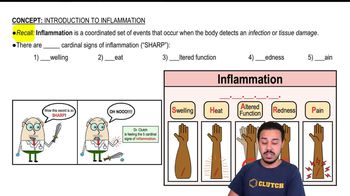
Identify the cardinal signs of inflammation: redness (rubor), heat (calor), swelling (tumor), pain (dolor), and loss of function (functio laesa).
Understand that vascular changes in early inflammation primarily include vasodilation and increased vascular permeability.
Explain how vasodilation increases blood flow to the affected area, which causes redness and heat due to the higher volume of warm blood in the tissue.
Describe how increased vascular permeability allows plasma proteins and leukocytes to exit the bloodstream and enter the tissue, leading to swelling (edema) and contributing to pain by stimulating nerve endings.
Summarize that these vascular changes create the environment necessary for immune cells to reach the site of injury or infection, thus generating the cardinal signs of inflammation.

Verified video answer for a similar problem:

This video solution was recommended by our tutors as helpful for the problem above.
Video duration:
3m
Was this helpful?

Key Concepts

Here are the essential concepts you must grasp in order to answer the question correctly.

Vascular Changes in Inflammation

Vascular changes during early inflammation include vasodilation and increased vascular permeability. These changes allow more blood flow and plasma proteins to reach the affected tissue, facilitating immune cell access and contributing to swelling and redness.
Recommended video:
Guided course
03:09
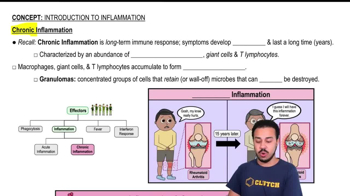
Chronic Inflammation

Cardinal Signs of Inflammation

The cardinal signs of inflammation are redness, heat, swelling, pain, and loss of function. These signs result from physiological responses such as increased blood flow, fluid accumulation, and activation of pain receptors at the injury site.
Recommended video:
Guided course
01:38
Introduction to Inflammation

Role of Endothelial Cells and Mediators

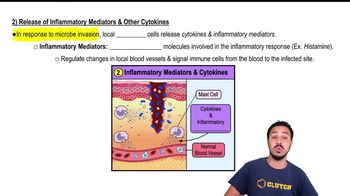
Endothelial cells lining blood vessels respond to inflammatory mediators like histamine by loosening junctions, increasing permeability. This allows immune cells and proteins to exit the bloodstream and enter tissues, driving the visible and functional changes seen in inflammation.
Recommended video:
Guided course
02:15
2) Release of Inflammatory Mediators & Other Cytokines