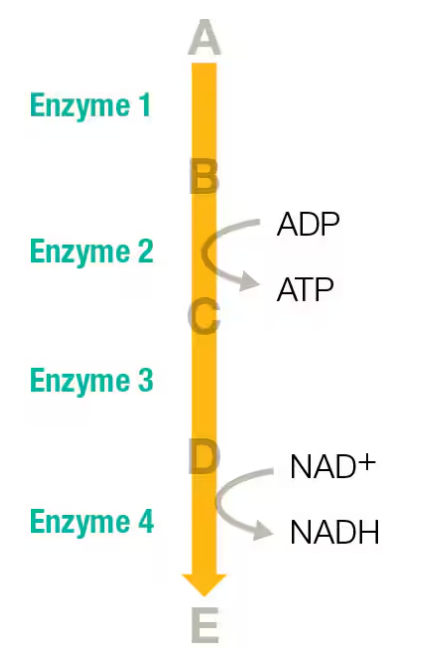
Use this pathway schematic to answer questions a through d. a. Which enzyme carries out a redox reaction? In this reaction, what is being reduced and what is being oxidized? b. Which enzyme would be the most likely to be regulated by feedback inhibition? c. What is the end product of this pathway? d. Which enzyme carries out substrate-level phosphorylation?
Verified step by step guidance
1
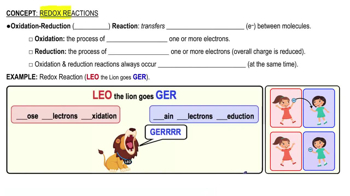
Step 1: Identify the enzyme that catalyzes a redox reaction by looking for the step where electrons are transferred between molecules. Redox reactions involve one molecule being oxidized (losing electrons) and another being reduced (gaining electrons). Determine which enzyme facilitates this electron transfer and specify the substrate that is oxidized and the one that is reduced in this step.
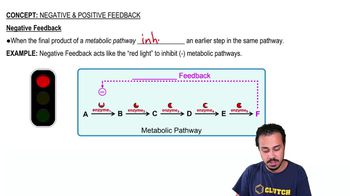
Step 2: To find the enzyme most likely regulated by feedback inhibition, look for the enzyme that catalyzes the first committed step of the pathway or an early step. Feedback inhibition typically occurs when the end product of the pathway binds to this enzyme to decrease its activity, preventing overproduction of the product.
Step 3: Identify the end product of the pathway by following the sequence of reactions from the initial substrate through each enzymatic step until the final product is formed. This is usually the molecule that accumulates and can regulate the pathway.
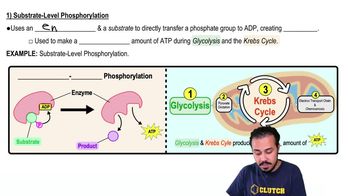
Step 4: Determine which enzyme carries out substrate-level phosphorylation by identifying the step where a high-energy phosphate group is directly transferred to ADP (or another nucleotide diphosphate) to form ATP (or another nucleotide triphosphate). This is distinct from oxidative phosphorylation and involves a direct enzymatic transfer.
Step 5: Summarize your findings by clearly naming each enzyme corresponding to the questions (a through d) and describing the role or reaction it catalyzes, ensuring you connect the biochemical concepts of redox reactions, feedback inhibition, pathway end products, and substrate-level phosphorylation.
Verified video answer for a similar problem:
This video solution was recommended by our tutors as helpful for the problem above
Video duration:
1m
Play a video:
Was this helpful?
Key Concepts
Here are the essential concepts you must grasp in order to answer the question correctly.
Redox Reactions in Enzymatic Pathways
Redox reactions involve the transfer of electrons between molecules, where one molecule is oxidized (loses electrons) and another is reduced (gains electrons). Enzymes that catalyze these reactions facilitate energy transfer and metabolic processes, often involving cofactors like NAD+/NADH.
Feedback inhibition is a regulatory mechanism where the end product of a metabolic pathway binds to an enzyme, usually the first committed step, to inhibit its activity. This prevents overproduction of the product and maintains metabolic balance.
Substrate-level phosphorylation is a process where a phosphate group is directly transferred from a phosphorylated substrate to ADP, forming ATP. This reaction is catalyzed by specific enzymes and occurs independently of the electron transport chain.