Most oxidation reactions in bacteria involve the _______. a. removal of hydrogen ions and electrons b. removal of oxygen c. addition of hydrogen ions and electrons d. addition of hydrogen ions
Verified step by step guidance
1
Understand the concept of oxidation in biological systems, which typically involves the loss of electrons.
Recognize that in bacterial oxidation reactions, the removal of electrons is often accompanied by the removal of hydrogen ions (protons).
Consider the options provided: removal of hydrogen ions and electrons, removal of oxygen, addition of hydrogen ions and electrons, and addition of hydrogen ions.
Recall that the removal of hydrogen ions and electrons is a common feature of oxidation reactions in bacteria.
Identify the option that aligns with the typical process of oxidation in bacteria, which involves the removal of hydrogen ions and electrons.
Verified video answer for a similar problem:
This video solution was recommended by our tutors as helpful for the problem above
Video duration:
1m
Play a video:
Was this helpful?
Key Concepts
Here are the essential concepts you must grasp in order to answer the question correctly.
Oxidation-Reduction Reactions
Oxidation-reduction (redox) reactions are chemical processes where electrons are transferred between molecules. In biological systems, oxidation typically involves the removal of electrons and hydrogen ions, leading to a decrease in the molecule's energy state. Understanding these reactions is crucial for grasping how bacteria generate energy through metabolic pathways.
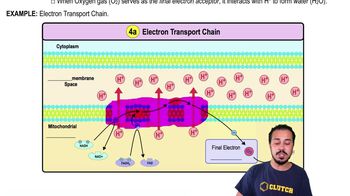
The electron transport chain (ETC) is a series of protein complexes located in the bacterial cell membrane that facilitate the transfer of electrons derived from oxidation reactions. As electrons move through the chain, they release energy used to pump protons across the membrane, creating a proton gradient that drives ATP synthesis. This process is fundamental to aerobic respiration in bacteria.
Metabolic pathways are sequences of chemical reactions occurring within a cell that convert substrates into products. In bacteria, these pathways include glycolysis, the Krebs cycle, and fermentation, all of which involve oxidation reactions. Understanding these pathways helps explain how bacteria utilize different substrates for energy production and growth.