Ch. 26 - Applied and Industrial Microbiology
Bauman - Microbiology with Diseases by Taxonomy 6th Edition
Bauman6th EditionMicrobiology with Diseases by TaxonomyISBN: 9780134832302Not the one you use?Change textbook
Chapter 26, Problem 10

Industrial fermentation _________.
a. Always involves alcohol production
b. Involves the large-scale production of any beneficial compound
c. Refers to the oxidation of sugars using organic electron acceptors
d. Is any desirable change to food by microbial metabolism

Verified step by step guidance
1
Step 1: Understand the term 'industrial fermentation' by breaking down its components. 'Fermentation' in microbiology refers to the metabolic process where microorganisms convert substrates (usually sugars) into products like alcohol, acids, or gases, often in the absence of oxygen.
Step 2: Analyze each option carefully. Option (a) states that industrial fermentation always involves alcohol production. Consider whether all industrial fermentations produce alcohol or if other products can be made.
Step 3: Look at option (b), which says industrial fermentation involves the large-scale production of any beneficial compound. Think about the scope of industrial fermentation and whether it is limited to alcohol or broader.
Step 4: Evaluate option (c), which mentions oxidation of sugars using organic electron acceptors. Recall that fermentation typically involves substrate-level phosphorylation and does not rely on external electron acceptors like in respiration.
Step 5: Consider option (d), which defines fermentation as any desirable change to food by microbial metabolism. Reflect on whether this definition fits the industrial fermentation context or if it is more related to food fermentation specifically.

Verified video answer for a similar problem:

This video solution was recommended by our tutors as helpful for the problem above.
Video duration:
3m
Was this helpful?

Key Concepts

Here are the essential concepts you must grasp in order to answer the question correctly.

Industrial Fermentation

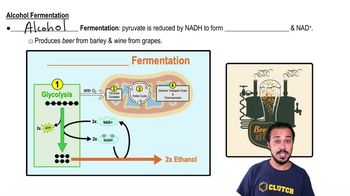
Industrial fermentation is the large-scale use of microbial metabolism to produce valuable products such as antibiotics, enzymes, vitamins, and biofuels. It involves controlled growth conditions to maximize yield and efficiency, not limited to alcohol production alone.
Recommended video:
Guided course
02:02
Alcohol Fermentation

Microbial Metabolism in Fermentation

Microbial metabolism during fermentation typically involves anaerobic processes where microbes convert substrates like sugars into products such as acids, gases, or alcohols. This process does not necessarily require oxygen and uses organic molecules as electron acceptors.
Recommended video:
Guided course
02:17
Introduction to Metabolism

Applications of Fermentation in Industry

Fermentation is applied in various industries to produce beneficial compounds on a large scale, including food additives, pharmaceuticals, and biofuels. It is distinct from food spoilage or simple oxidation reactions and focuses on desirable, controlled biochemical changes.
Recommended video:
Guided course
02:02
Alcohol Fermentation