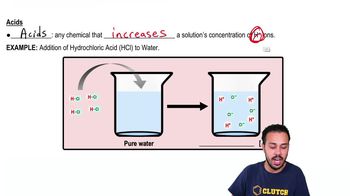
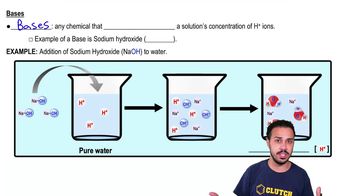
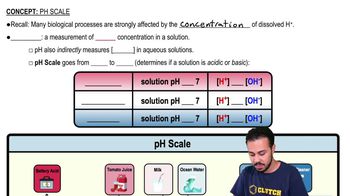
Acids donate _______________________ to an aqueous solution, which will lead to a(n) _______________________ in pH. In contrast, bases donate _______________________ to an aqueous solution and will _______________________ the pH. The pH of a solution with more OH− than H+ will have a(n) _______________________ pH.
Verified step by step guidance
1
Understand the definition of acids and bases in terms of their behavior in aqueous solutions: acids donate protons (H+ ions), while bases donate hydroxide ions (OH−).
Fill in the first blank by recognizing that acids donate \( \text{H}^+ \) ions to an aqueous solution.
For the second blank, recall that donating \( \text{H}^+ \) ions increases the acidity of the solution, which causes the pH to decrease.
Fill in the third blank by noting that bases donate \( \text{OH}^- \) ions to an aqueous solution.
For the fourth and fifth blanks, understand that bases increase the concentration of hydroxide ions, which raises the pH, so the pH of a solution with more \( \text{OH}^- \) than \( \text{H}^+ \) will be higher (alkaline).
Verified video answer for a similar problem:
This video solution was recommended by our tutors as helpful for the problem above
Video duration:
5m
Play a video:
Was this helpful?
Key Concepts
Here are the essential concepts you must grasp in order to answer the question correctly.
Acids and Proton Donation
Acids are substances that donate hydrogen ions (H⁺) or protons to an aqueous solution. This increase in H⁺ concentration causes the solution to become more acidic, resulting in a decrease in pH.
Bases are substances that donate hydroxide ions (OH⁻) to an aqueous solution. The addition of OH⁻ reduces the concentration of free H⁺ ions, causing the solution to become more basic or alkaline, which increases the pH.
The pH scale measures the acidity or alkalinity of a solution based on H⁺ concentration. A solution with more OH⁻ than H⁺ ions is basic and has a pH greater than 7, while a solution with more H⁺ than OH⁻ is acidic with a pH less than 7.