Which of the following sequences reflects the correct order of events in mitosis?
a. telophase, anaphase, metaphase, prophase b. prophase, anaphase, metaphase, telophase c. telophase, prophase, metaphase, anaphase d. prophase, metaphase, anaphase, telophase
Verified step by step guidance
1
Identify the main stages of mitosis: prophase, metaphase, anaphase, and telophase.
Understand that mitosis is the process of cell division where a single cell divides to produce two identical daughter cells.
Recall that prophase is the first stage where chromatin condenses into visible chromosomes.
Recognize that metaphase follows prophase, where chromosomes align at the cell's equatorial plate.
Remember that anaphase and telophase follow, with anaphase involving the separation of sister chromatids and telophase involving the reformation of the nuclear envelope.
Verified video answer for a similar problem:
This video solution was recommended by our tutors as helpful for the problem above
Video duration:
2m
Play a video:
Was this helpful?
Key Concepts
Here are the essential concepts you must grasp in order to answer the question correctly.
Mitosis Stages
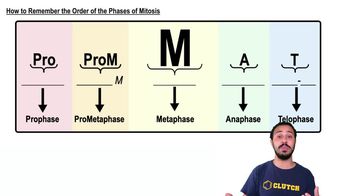
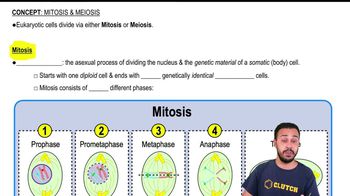
Mitosis is a process of cell division that consists of several distinct stages: prophase, metaphase, anaphase, and telophase. Each stage plays a critical role in ensuring that the genetic material is accurately replicated and distributed to the daughter cells. Understanding the sequence of these stages is essential for grasping how cells divide and maintain genetic continuity.
Prophase is the first stage of mitosis, where chromatin condenses into visible chromosomes, and the nuclear envelope begins to break down. The mitotic spindle starts to form, and spindle fibers extend from the centrosomes to the chromosomes. This stage is crucial for preparing the chromosomes for alignment and separation.
How to Remember the Order of the Phases of Mitosis
Metaphase, Anaphase, and Telophase
Following prophase, metaphase involves the alignment of chromosomes at the cell's equatorial plane. Anaphase is characterized by the separation of sister chromatids, which are pulled toward opposite poles of the cell. Finally, telophase marks the reformation of the nuclear envelope around each set of chromosomes, leading to the completion of mitosis and the eventual division of the cytoplasm.