Inclusions have been found to contain ___________ .
a. DNA b. sulfur globules c. dipicolinic acid d. tubulin
Verified step by step guidance
1
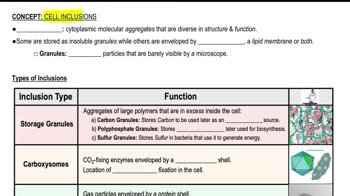
Understand what inclusions are in the context of microbiology. Inclusions are reserve deposits found within the cytoplasm of prokaryotic cells.
Identify the types of substances that can be stored in inclusions. These can include nutrients, metabolic byproducts, or other substances.
Consider the options provided: a. DNA, b. sulfur globules, c. dipicolinic acid, d. tubulin.
Recall that sulfur globules are a common type of inclusion found in some bacteria, particularly those that oxidize sulfur compounds.
Conclude that the correct answer is the option that matches a known type of inclusion, which in this case is sulfur globules.
Verified video answer for a similar problem:
This video solution was recommended by our tutors as helpful for the problem above
Video duration:
2m
Play a video:
Was this helpful?
Key Concepts
Here are the essential concepts you must grasp in order to answer the question correctly.
Inclusions in Microbiology
Inclusions are intracellular aggregates of substances that can be found in various microorganisms. They serve as storage sites for nutrients, energy reserves, or metabolic byproducts. Common types of inclusions include lipid droplets, glycogen granules, and sulfur globules, which can be utilized by the cell under specific conditions.
Sulfur globules are a type of inclusion found in certain bacteria, particularly those involved in sulfur metabolism. These globules consist of elemental sulfur and serve as energy reserves for bacteria that oxidize sulfur compounds. They are often visible under a microscope and can indicate the metabolic capabilities of the organism.
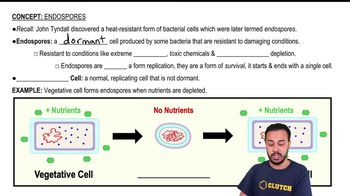
Dipicolinic acid is a compound found in the spores of certain bacteria, particularly in the genus Bacillus and Clostridium. It plays a crucial role in spore stability and resistance to environmental stresses. While it is an important component of bacterial spores, it is not typically found in inclusions, distinguishing it from other storage materials.