Patients with Chédiak-Higashi syndrome suffer from various types of cancer. These patients are most likely lacking which of the following? a. Treg cells b. TH1 cells c. B cells d. NK cells e. TH2 cells
Verified step by step guidance
1
Step 1: Understand the nature of Chédiak-Higashi syndrome. It is a rare genetic disorder characterized by defects in lysosomal trafficking, which affects the function of certain immune cells, particularly those involved in killing infected or abnormal cells.
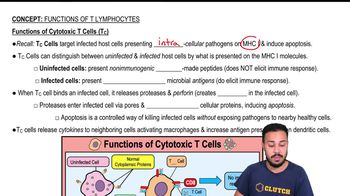
Step 2: Recall that patients with Chédiak-Higashi syndrome have impaired function of natural killer (NK) cells and cytotoxic T lymphocytes due to defective lysosomal granule formation, which is crucial for their ability to kill target cells.
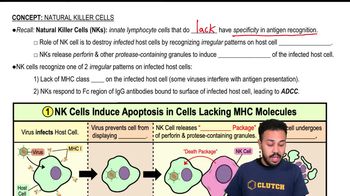
Step 3: Recognize that the deficiency or dysfunction of NK cells leads to increased susceptibility to infections and cancers, as NK cells play a key role in immune surveillance against tumor cells.
Step 4: Review the options given: Treg cells, TH1 cells, B cells, NK cells, and TH2 cells. Among these, NK cells are the immune cells primarily affected in Chédiak-Higashi syndrome.
Step 5: Conclude that the patients with Chédiak-Higashi syndrome are most likely lacking functional NK cells, which explains their increased risk of cancers.
Verified video answer for a similar problem:
This video solution was recommended by our tutors as helpful for the problem above
Video duration:
3m
Play a video:
Was this helpful?
Key Concepts
Here are the essential concepts you must grasp in order to answer the question correctly.
Chédiak-Higashi Syndrome and Immune Dysfunction
Chédiak-Higashi syndrome is a rare genetic disorder characterized by defects in lysosomal trafficking, leading to impaired function of immune cells such as neutrophils and natural killer (NK) cells. This defect results in increased susceptibility to infections and certain cancers due to compromised immune surveillance.
Role of Natural Killer (NK) Cells in Cancer Surveillance
NK cells are critical components of the innate immune system that identify and destroy tumor cells and virus-infected cells without prior sensitization. Their cytotoxic activity helps prevent cancer development by eliminating abnormal cells early, making their deficiency linked to increased cancer risk.
Differences Between T Cell Subsets and Their Functions
T cell subsets, including Treg, TH1, and TH2 cells, have distinct roles: Treg cells regulate immune tolerance, TH1 cells promote cell-mediated immunity, and TH2 cells support humoral immunity. While important, deficiencies in these subsets are less directly associated with cancer susceptibility compared to NK cell dysfunction.