
Textbook Question
____________________ is a recombination event that occurs during gamete formation in eukaryotes.
1358
views

 Verified step by step guidance
 04:41
04:41
 04:16
04:16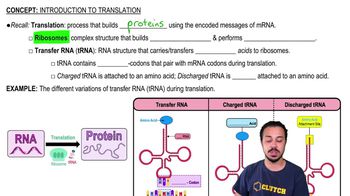 06:12
06:12____________________ is a recombination event that occurs during gamete formation in eukaryotes.
Which of the following methods of DNA repair involves enzymes that recognize and correct nucleotide errors in unmethylated strands of DNA?
a. Light repair of T dimers
b. Dark repair of P dimers
c. Mismatch repair
d. SOS response
Compare and contrast the processes of transformation, transduction, and conjugation.
Which of the following is not a mechanism of genetic transfer between cells?
a. Transduction
b. Transformation
c. Transcription
d. Conjugation
__________ are nucleotide sequences containing palindromes and genes for proteins that cut DNA strands.
__________ RNA carries amino acids.