Contrast the following active processes for transporting materials into or out of a cell: active transport, group translocation, endocytosis, exocytosis.
Verified step by step guidance
1
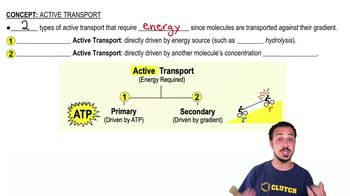
Identify the key characteristics of active transport, which involves the movement of molecules across a cell membrane from a region of lower concentration to a region of higher concentration using energy, typically in the form of ATP.
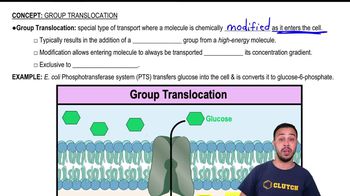
Examine group translocation, a process where a molecule is chemically modified as it is transported into the cell, ensuring that the molecule cannot exit the cell once inside.
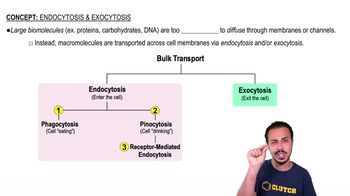
Explore endocytosis, a process by which cells internalize substances from their external environment by engulfing them with their cell membrane, forming a vesicle.
Discuss exocytosis, the process by which cells expel materials to the external environment by fusing a vesicle with the cell membrane, releasing its contents outside the cell.
Compare and contrast these processes by considering factors such as energy requirement, direction of transport, and whether the process involves modification of the transported substance or the formation of vesicles.
Verified video answer for a similar problem:
This video solution was recommended by our tutors as helpful for the problem above
Video duration:
3m
Play a video:
Was this helpful?
Key Concepts
Here are the essential concepts you must grasp in order to answer the question correctly.
Active Transport
Active transport is a cellular process that moves molecules across a membrane against their concentration gradient, requiring energy, typically in the form of ATP. This mechanism is crucial for maintaining cellular homeostasis, allowing cells to uptake essential nutrients and expel waste products. An example includes the sodium-potassium pump, which regulates ion concentrations in nerve cells.
Endocytosis and exocytosis are processes that involve the transport of large molecules or particles into and out of the cell, respectively, via vesicles. In endocytosis, the cell membrane engulfs extracellular material, forming a vesicle that brings substances into the cell. Conversely, exocytosis involves the fusion of vesicles with the plasma membrane to release their contents outside the cell, playing a vital role in secretion and communication.
Group translocation is a unique transport mechanism primarily found in bacteria, where a molecule is chemically modified during its passage across the membrane. This process not only facilitates the uptake of nutrients but also prevents the molecule from diffusing back out of the cell. An example is the phosphotransferase system, which transports glucose while simultaneously phosphorylating it, thus trapping it within the cell.