
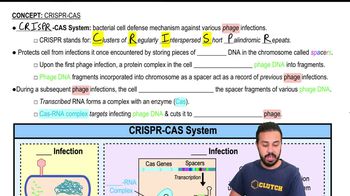
CRISPR stands for 'Clustered Regularly Interspaced Short Palindromic Repeats' and is a natural system used by bacteria as a defense mechanism against viruses.
The CRISPR system consists of two main components: the CRISPR array, which contains sequences of DNA from past viral invaders, and the Cas (CRISPR-associated) proteins, which are enzymes that can cut DNA.
When a virus attacks a bacterium, the CRISPR system can recognize the viral DNA if it matches a sequence in the CRISPR array. The Cas proteins are then guided to the viral DNA by RNA transcribed from the CRISPR array.
The Cas proteins, such as Cas9, act like molecular scissors to cut the viral DNA, thereby neutralizing the threat by preventing the virus from replicating.
CRISPR has been adapted for use in genetic engineering, allowing scientists to edit genes with high precision, which has applications in medicine, agriculture, and research.
Verified video answer for a similar problem:
This video solution was recommended by our tutors as helpful for the problem above
Video duration:
3m
Play a video:
Was this helpful?
Key Concepts
Here are the essential concepts you must grasp in order to answer the question correctly.
CRISPR Mechanism
CRISPR (Clustered Regularly Interspaced Short Palindromic Repeats) is a natural defense mechanism found in bacteria that allows them to recognize and cut foreign DNA, such as that from viruses. It involves a guide RNA that matches the target DNA sequence and a Cas (CRISPR-associated) protein that performs the cutting. This system has been adapted for precise genome editing in various organisms.
Genome editing refers to the techniques used to alter the genetic material of an organism. CRISPR technology enables targeted modifications, such as gene knockouts or insertions, with high efficiency and specificity. This capability has vast applications in research, agriculture, and medicine, including the potential to correct genetic disorders.
The applications of CRISPR technology are diverse and impactful. In medicine, it holds promise for treating genetic diseases, developing new therapies, and advancing cancer research. In agriculture, CRISPR can enhance crop resilience and yield. Its versatility makes it a revolutionary tool in biotechnology and genetic engineering.