Why must NADH be reoxidized? How does this happen in an organism that uses respiration? Fermentation?
Verified step by step guidance
1
Understand that NADH is the reduced form of NAD+, a crucial coenzyme that carries electrons during metabolic reactions. NAD+ must be available in its oxidized form to accept electrons and continue glycolysis and other metabolic pathways.
Recognize that if NADH is not reoxidized back to NAD+, the cell will run out of NAD+ and metabolic processes like glycolysis will halt, stopping ATP production and energy generation.
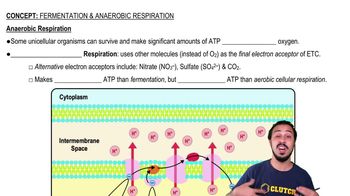
In organisms that use respiration, NADH is reoxidized by transferring its electrons to the electron transport chain (ETC). This process occurs in the mitochondria (or plasma membrane in prokaryotes), where electrons pass through a series of carriers and ultimately reduce oxygen to water, regenerating NAD+.
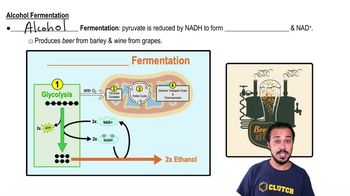
In organisms that rely on fermentation, NADH is reoxidized by transferring electrons to an organic molecule (such as pyruvate or a derivative), which acts as the final electron acceptor. This regenerates NAD+ without the use of an electron transport chain or oxygen.
Summarize that the key difference is that respiration uses an external electron acceptor (like oxygen) and an ETC to regenerate NAD+, while fermentation uses internal organic molecules to accept electrons and regenerate NAD+ to sustain glycolysis.
Verified video answer for a similar problem:
This video solution was recommended by our tutors as helpful for the problem above.
Video duration:
2m
Play a video:
0 Comments
Key Concepts
Here are the essential concepts you must grasp in order to answer the question correctly.
Role of NADH in Cellular Metabolism
NADH is a key electron carrier that stores energy by accepting electrons during metabolic reactions. It must be reoxidized to NAD+ to maintain the balance of redox reactions and allow glycolysis and other pathways to continue producing ATP.
In organisms that use respiration, NADH is reoxidized by transferring electrons to the electron transport chain, ultimately reducing oxygen to water. This process regenerates NAD+ and produces a large amount of ATP through oxidative phosphorylation.
In fermentation, NADH is reoxidized by transferring electrons to organic molecules, such as pyruvate or its derivatives, instead of oxygen. This regenerates NAD+ to sustain glycolysis but produces less ATP compared to respiration.

 2:57 minutes
 Verified step by step guidance
 02:17
02:17