Define oxidation-reduction, and differentiate the following terms: a. Aerobic and anaerobic respiration b. Respiration and fermentation c. Cyclic and noncyclic photophosphorylation
Verified step by step guidance
1
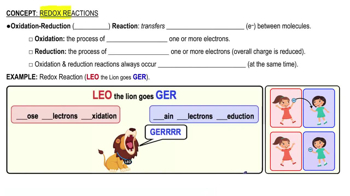
Start by defining oxidation-reduction (redox) reactions: these are chemical reactions where electrons are transferred between molecules. Oxidation refers to the loss of electrons, while reduction refers to the gain of electrons. This electron transfer is fundamental to many metabolic processes in microbiology.
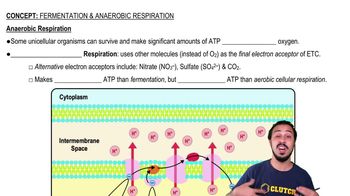
Differentiate aerobic and anaerobic respiration: Aerobic respiration requires oxygen as the final electron acceptor in the electron transport chain, producing energy efficiently. Anaerobic respiration, on the other hand, uses molecules other than oxygen (such as nitrate or sulfate) as the final electron acceptor, often yielding less energy.
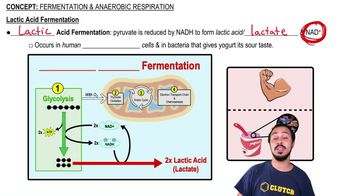
Compare respiration and fermentation: Respiration (both aerobic and anaerobic) involves an electron transport chain and a final electron acceptor, leading to oxidative phosphorylation and higher ATP yield. Fermentation does not use an electron transport chain; instead, it relies on substrate-level phosphorylation and organic molecules as electron acceptors, producing less ATP.
Explain cyclic and noncyclic photophosphorylation: Cyclic photophosphorylation involves electrons cycling back to the photosystem, producing ATP but no NADPH or oxygen. Noncyclic photophosphorylation involves a linear flow of electrons from water to NADP+, producing ATP, NADPH, and oxygen as a byproduct.
Summarize the key differences by focusing on the presence or absence of oxygen, the type of electron acceptors, the involvement of electron transport chains, and the products formed in each process.
Verified video answer for a similar problem:
This video solution was recommended by our tutors as helpful for the problem above.
Video duration:
2m
Play a video:
0 Comments
Key Concepts
Here are the essential concepts you must grasp in order to answer the question correctly.
Oxidation-Reduction (Redox) Reactions
Oxidation-reduction reactions involve the transfer of electrons between molecules, where oxidation is the loss of electrons and reduction is the gain. These reactions are fundamental in cellular metabolism, enabling energy transfer through electron carriers like NAD+ and FAD.
Aerobic respiration uses oxygen as the final electron acceptor to produce energy efficiently, while anaerobic respiration uses other molecules like nitrate or sulfate instead of oxygen. Both processes generate ATP but differ in electron acceptors and energy yield.
Respiration involves complete oxidation of substrates with an electron transport chain and a final electron acceptor, producing more ATP. Fermentation is an anaerobic process that partially breaks down substrates without an electron transport chain, yielding less ATP and producing organic end products.

 2:43 minutes
 Verified step by step guidance
 04:46
04:46