Besides the fact that it synthesizes RNA, how does RNA polymerase differ in function from DNA polymerase?
Verified step by step guidance
1
Understand the basic functions of RNA polymerase and DNA polymerase: RNA polymerase synthesizes RNA from a DNA template, while DNA polymerase synthesizes DNA from a DNA template.
Consider the substrates used by each enzyme: RNA polymerase uses ribonucleotides (ATP, UTP, CTP, GTP), whereas DNA polymerase uses deoxyribonucleotides (dATP, dTTP, dCTP, dGTP).
Examine the role in transcription and replication: RNA polymerase is involved in transcription, creating an RNA copy of a gene, while DNA polymerase is involved in DNA replication, creating a duplicate of the entire DNA molecule.
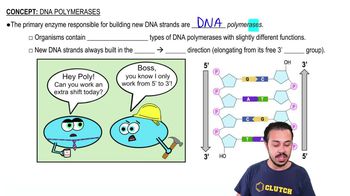
Analyze the requirement for a primer: DNA polymerase requires a primer to initiate synthesis, whereas RNA polymerase can start RNA synthesis de novo, without a primer.
Consider proofreading abilities: DNA polymerase has proofreading activity to correct errors during DNA synthesis, while RNA polymerase generally lacks this ability, leading to a higher error rate in RNA synthesis.
Verified video answer for a similar problem:
This video solution was recommended by our tutors as helpful for the problem above
Video duration:
3m
Play a video:
Was this helpful?
Key Concepts
Here are the essential concepts you must grasp in order to answer the question correctly.
RNA Polymerase Function
RNA polymerase is an enzyme responsible for synthesizing RNA from a DNA template during the process of transcription. Unlike DNA polymerase, which requires a primer to initiate synthesis, RNA polymerase can start RNA synthesis de novo, meaning it can begin the process without a pre-existing strand. This allows for the rapid production of RNA molecules, which are essential for protein synthesis and gene regulation.
DNA polymerase is an enzyme that synthesizes new DNA strands by adding nucleotides complementary to a template strand during DNA replication. It requires a primer to initiate synthesis and is involved in proofreading and correcting errors in the newly synthesized DNA. This ensures the fidelity of genetic information is maintained during cell division, which is crucial for genetic stability.
Transcription and replication are two fundamental processes in molecular biology. Transcription is the process of copying a segment of DNA into RNA, primarily involving RNA polymerase, while replication is the duplication of the entire DNA molecule, involving DNA polymerase. These processes differ in their purpose, with transcription focusing on gene expression and replication ensuring genetic continuity during cell division.