
Transcription produces _____________ . a. DNA molecules b. RNA molecules c. Polypeptides d. Palindromes
Verified step by step guidance
1
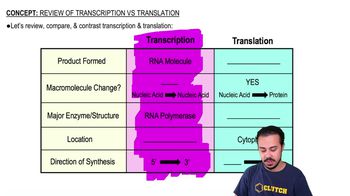
Understand the process of transcription in molecular biology: Transcription is the process by which the genetic information encoded in DNA is copied into RNA.
Recall that during transcription, an RNA polymerase enzyme reads the DNA template strand and synthesizes a complementary RNA strand.
Recognize that the product of transcription is an RNA molecule, which can be messenger RNA (mRNA), transfer RNA (tRNA), or ribosomal RNA (rRNA), depending on the gene being transcribed.
Eliminate options that do not fit the product of transcription: DNA molecules are produced by replication, polypeptides are produced by translation, and palindromes are sequences, not molecules produced by transcription.
Conclude that the correct answer is the production of RNA molecules during transcription.
Verified video answer for a similar problem:
This video solution was recommended by our tutors as helpful for the problem above
Video duration:
3m
Play a video:
Was this helpful?
Key Concepts
Here are the essential concepts you must grasp in order to answer the question correctly.
Transcription Process
Transcription is the process by which a segment of DNA is copied into RNA by the enzyme RNA polymerase. It occurs in the cell nucleus and results in the formation of an RNA molecule complementary to the DNA template strand.
RNA (ribonucleic acid) is a nucleic acid involved in various cellular functions, including carrying genetic information from DNA to the ribosome for protein synthesis. Types of RNA include mRNA, tRNA, and rRNA, all produced during transcription.
Transcription produces RNA molecules from DNA, while translation uses mRNA to synthesize polypeptides (proteins). Understanding this distinction helps clarify that transcription does not produce DNA or proteins directly.