Indicate which statements are true. Correct all false statements by changing the underlined words. __________ The surface cells of mucous membranes are alive.
Verified step by step guidance
1
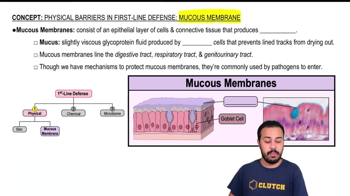
Understand the structure of mucous membranes: Mucous membranes consist of an epithelial layer that covers body cavities and passages exposed to the external environment, such as the respiratory, digestive, and urogenital tracts.
Recall that the surface cells of mucous membranes are typically epithelial cells that are alive, as they perform functions like secretion and absorption, and they maintain the integrity of the membrane.
Identify the statement: 'The surface cells of mucous membranes are alive.' Since epithelial cells on mucous membranes are indeed living cells, this statement is true.
No correction is needed because the statement is accurate; the surface cells of mucous membranes are alive.
Summarize that mucous membranes differ from keratinized surfaces (like skin) where the outermost cells may be dead, but mucous membranes maintain living surface cells to perform their protective and secretory roles.
Verified video answer for a similar problem:
This video solution was recommended by our tutors as helpful for the problem above
Video duration:
2m
Play a video:
Was this helpful?
Key Concepts
Here are the essential concepts you must grasp in order to answer the question correctly.
Structure and Function of Mucous Membranes
Mucous membranes line body cavities and canals exposed to the external environment, such as the respiratory and digestive tracts. They consist of epithelial cells that can be alive and actively involved in secretion and protection, supported by underlying connective tissue.
The surface cells of mucous membranes are typically alive, unlike the dead, keratinized cells found on the skin's surface. These living cells maintain barrier functions and secrete mucus to trap pathogens and particles.
Unlike the skin's outer layer, which is composed of dead keratinized cells, mucous membranes have living epithelial cells on their surface. This distinction is important for understanding their roles in protection and interaction with the environment.