Ch. 7 - Microbial Genetics
Bauman - Microbiology with Diseases by Taxonomy 6th Edition
Bauman6th EditionMicrobiology with Diseases by TaxonomyISBN: 9780134832302Not the one you use?Change textbook
Chapter 7, Problem 3

Compare and contrast introns and exons.

Verified step by step guidance
1
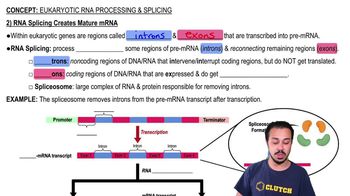
Define introns and exons clearly: Introns are non-coding sequences within a gene that are removed during RNA processing, while exons are coding sequences that remain in the mature mRNA and code for proteins.
Explain the role of introns: Introns are transcribed into pre-mRNA but are spliced out before translation, playing roles in gene regulation and alternative splicing.
Describe the function of exons: Exons contain the actual genetic information that is translated into amino acid sequences, forming the final protein product.
Compare their presence in the gene and mature mRNA: Introns are present in the DNA and pre-mRNA but absent in mature mRNA; exons are present in both DNA and mature mRNA.
Highlight the biological significance: Discuss how introns contribute to genetic diversity through alternative splicing, whereas exons determine the protein structure and function.

Verified video answer for a similar problem:

This video solution was recommended by our tutors as helpful for the problem above.
Video duration:
2m
Was this helpful?

Key Concepts

Here are the essential concepts you must grasp in order to answer the question correctly.

Introns

Introns are non-coding sequences within a gene that are transcribed into RNA but removed during RNA splicing before translation. They do not code for proteins and can play roles in gene regulation and alternative splicing.
Recommended video:
Guided course
08:44
2) RNA Splicing Creates Mature mRNA

Exons

Exons are coding sequences in a gene that remain in the mature mRNA after splicing and are translated into proteins. They contain the actual genetic information that determines the amino acid sequence of a protein.
Recommended video:
Guided course
08:44
2) RNA Splicing Creates Mature mRNA

RNA Splicing

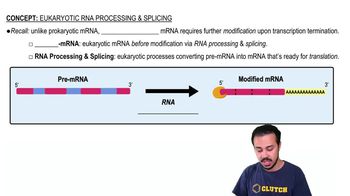
RNA splicing is the process by which introns are removed from the pre-mRNA transcript and exons are joined together. This process is essential for producing a continuous coding sequence that can be translated into a functional protein.
Recommended video:
Guided course
02:32
Eukaryotic RNA Processing and Splicing