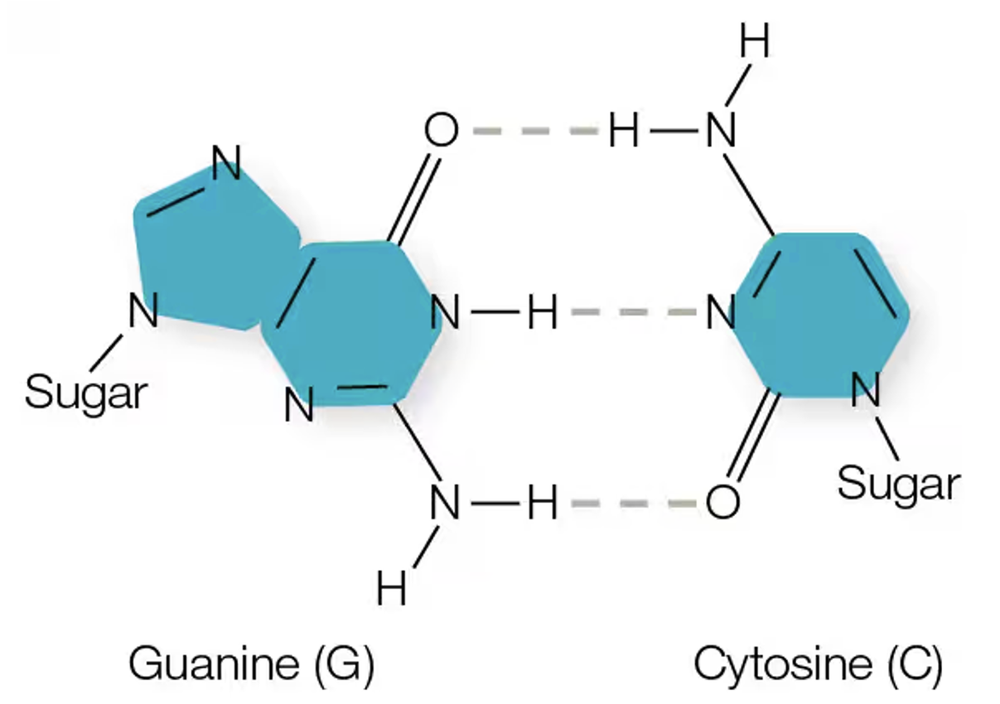
CIRCLE two covalent bonds and two hydrogen bonds in this image; label them. BOX a polar covalent bond.
Verified step by step guidance
1
Identify covalent bonds by looking for pairs of atoms sharing electrons within the same molecule. These bonds are typically represented by solid lines connecting atoms. Circle two such bonds where atoms share electrons equally or unequally.
Locate hydrogen bonds, which are weaker interactions often shown as dashed or dotted lines between a hydrogen atom attached to an electronegative atom (like oxygen or nitrogen) and another electronegative atom. Circle two of these hydrogen bonds and label them accordingly.
To find a polar covalent bond, look for a bond between two atoms with different electronegativities where electrons are shared unequally, causing partial charges. This bond is usually a solid line but with a dipole indicated (e.g., δ+ and δ-). Draw a box around one such bond and label it as a polar covalent bond.
Review the image carefully to ensure that the circled covalent bonds are within molecules, the circled hydrogen bonds are between molecules or within different parts of a large molecule, and the boxed polar covalent bond shows unequal electron sharing.
Label each circled and boxed bond clearly, using terms like 'Covalent Bond,' 'Hydrogen Bond,' and 'Polar Covalent Bond' to reinforce your understanding of the types of chemical interactions present.
Verified video answer for a similar problem:
This video solution was recommended by our tutors as helpful for the problem above
Video duration:
1m
Play a video:
Was this helpful?
Key Concepts
Here are the essential concepts you must grasp in order to answer the question correctly.
Covalent Bonds
Covalent bonds are strong chemical bonds formed by the sharing of electron pairs between atoms. They can be nonpolar, where electrons are shared equally, or polar, where electrons are shared unequally due to differences in electronegativity. These bonds form the backbone of molecules.
Hydrogen bonds are weak, non-covalent interactions that occur when a hydrogen atom covalently bonded to an electronegative atom (like oxygen or nitrogen) is attracted to another electronegative atom. They play a key role in stabilizing structures like DNA and proteins.
Polar covalent bonds occur when electrons are shared unequally between atoms with different electronegativities, creating partial positive and negative charges. This polarity influences molecular interactions and properties such as solubility and hydrogen bonding.