What is the function of glycocalyces and fimbriae in forming a biofilm?
Verified step by step guidance
1
Understand that both glycocalyces and fimbriae are surface structures found on bacterial cells that play crucial roles in biofilm formation.
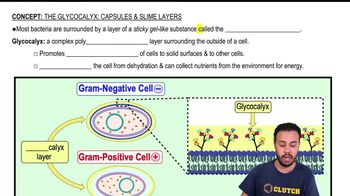
Recognize that glycocalyces, which include capsules and slime layers, primarily function to help bacteria adhere to surfaces and to each other, providing a sticky matrix that stabilizes the biofilm structure.
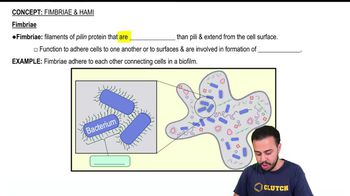
Know that fimbriae are hair-like appendages that facilitate the initial attachment of bacterial cells to surfaces by binding to specific receptors, which is essential for the early stages of biofilm development.
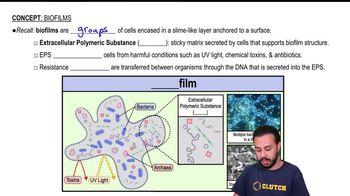
Combine these roles by explaining that fimbriae enable bacteria to anchor themselves firmly to a surface, while glycocalyces produce the extracellular polymeric substances (EPS) that encase the cells, promoting cohesion and protection within the biofilm.
Summarize that together, glycocalyces and fimbriae contribute to the establishment, maintenance, and resilience of biofilms by mediating adhesion and creating a protective environment for bacterial communities.
Verified video answer for a similar problem:
This video solution was recommended by our tutors as helpful for the problem above
Video duration:
2m
Play a video:
Was this helpful?
Key Concepts
Here are the essential concepts you must grasp in order to answer the question correctly.
Glycocalyx Structure and Function
The glycocalyx is a sticky, gelatinous layer composed mainly of polysaccharides that surrounds some bacterial cells. It helps bacteria adhere to surfaces and protects them from environmental stresses. In biofilm formation, the glycocalyx acts as a matrix that holds cells together and anchors the biofilm to surfaces.
Fimbriae are short, hair-like protein structures on the bacterial surface that facilitate attachment to surfaces and other cells. They play a critical role in the initial stages of biofilm formation by enabling bacteria to stick firmly to a substrate, which is essential for establishing a stable biofilm community.
A biofilm is a complex community of microorganisms embedded in a self-produced extracellular matrix. This structure provides protection from antibiotics and immune responses, enhances nutrient acquisition, and allows communication between cells. Glycocalyces and fimbriae are key components that enable the development and maintenance of biofilms.