Ch. 19 - Disorders Associated with the Immune System
Tortora - Microbiology: An Introduction 14th Edition
Tortora14th EditionMicrobiology: An IntroductionISBN: 9780138200398Not the one you use?Change textbook
Chapter 19, Problem 1

Desensitization to prevent an allergic response can be accomplished by injecting small, repeated doses of:
a. IgE antibodies
b. The antigen (allergen)
c. Histamine
d. IgG antibodies
e. Antihistamine

Verified step by step guidance
1
Understand the concept of desensitization in allergy treatment: it involves gradually exposing the immune system to increasing amounts of the allergen to build tolerance and reduce allergic reactions.
Recall that desensitization is typically done by injecting small, repeated doses of the allergen itself, not antibodies or histamine, to modify the immune response.
Recognize that injecting IgE antibodies would worsen the allergic response since IgE mediates allergy symptoms, so this is not used for desensitization.
Note that injecting histamine or antihistamines directly is not a method of desensitization; histamine causes symptoms, and antihistamines block symptoms but do not induce tolerance.
Conclude that the correct approach is injecting small, repeated doses of the antigen (allergen) to safely train the immune system to become less reactive.

Verified video answer for a similar problem:

This video solution was recommended by our tutors as helpful for the problem above.
Video duration:
1m
Was this helpful?

Key Concepts

Here are the essential concepts you must grasp in order to answer the question correctly.

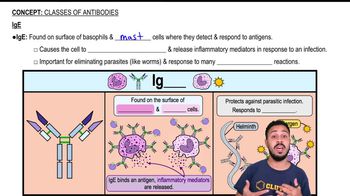
Allergic Response and IgE Antibodies

An allergic response is triggered when IgE antibodies recognize an allergen, leading to the release of histamine and other chemicals from mast cells. This causes symptoms like inflammation and itching. Understanding the role of IgE is crucial to grasp how allergies develop and how they can be modulated.
Recommended video:

Desensitization (Allergen Immunotherapy)

Desensitization involves administering gradually increasing doses of the allergen to the patient. This process helps the immune system develop tolerance, reducing the allergic reaction over time by shifting the immune response away from IgE-mediated pathways.
Recommended video:
Guided course
04:43
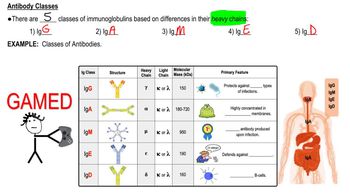
Classes of Antibodies

Role of IgG Antibodies in Allergy Treatment

IgG antibodies can block allergens from binding to IgE on mast cells, preventing allergic reactions. During desensitization, the immune system often produces more IgG, which acts as a 'blocking antibody' and contributes to the reduction of allergy symptoms.
Recommended video:
Guided course
03:48
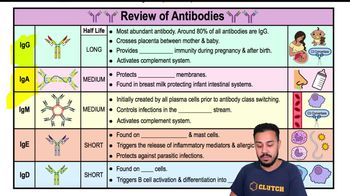
Review Table of Immunoglobin Classes