
In Section 10.8.1, you learned that alkenes react more quickly with electrophiles than do the corresponding alkynes (kalkene/kalkyne > 1). Explain why there is a greater disparity in the alkene versus alkyne reactivity in the addition of HBr as compared to the addition of Br2 [The rate data are not real, but are meant to illustrate a real trend.]
Verified step by step guidance
1
Step 1: Analyze the provided image. The left side shows the relative rates of reaction for alkenes and alkynes with HBr, where the alkene reacts 100 times faster than the alkyne (kalkene/kalkyne = 100). The right side shows the relative rates of reaction for alkenes and alkynes with Br₂, where the alkene reacts 10 times faster than the alkyne (kalkene/kalkyne = 10).
Step 2: Recall the mechanism of addition reactions. In the case of HBr addition, the reaction proceeds via the formation of a carbocation intermediate. Alkenes form more stable carbocations due to hyperconjugation and inductive effects, whereas alkynes form less stable carbocations because the sp-hybridized carbon in alkynes is less able to stabilize positive charge.
Step 3: Compare the Br₂ addition mechanism. This reaction proceeds via a cyclic bromonium ion intermediate rather than a carbocation. The disparity in reactivity between alkenes and alkynes is smaller because the bromonium ion formation is less sensitive to the hybridization of the carbon atoms involved.
Step 4: Explain the greater disparity in HBr addition. The stability of the carbocation intermediate in HBr addition is the key factor that makes alkenes react much faster than alkynes. In contrast, the Br₂ addition mechanism does not involve carbocation formation, so the difference in reactivity is less pronounced.
Step 5: Conclude that the difference in reactivity trends is due to the nature of the intermediates formed during the reaction. HBr addition is highly dependent on carbocation stability, favoring alkenes, while Br₂ addition involves a bromonium ion intermediate, which reduces the disparity in reactivity between alkenes and alkynes.
Verified video answer for a similar problem:
This video solution was recommended by our tutors as helpful for the problem above
Play a video:
Was this helpful?
Key Concepts
Here are the essential concepts you must grasp in order to answer the question correctly.
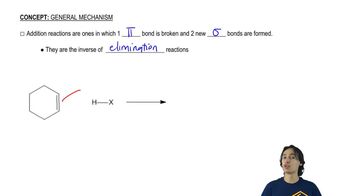
Electrophilic Addition Reactions
Electrophilic addition reactions involve the addition of electrophiles to nucleophilic sites in alkenes and alkynes. Alkenes, with their π bonds, are more reactive towards electrophiles due to the availability of electron density. This reactivity is influenced by the stability of the resulting carbocation intermediates formed during the reaction, which can differ significantly between alkenes and alkynes.
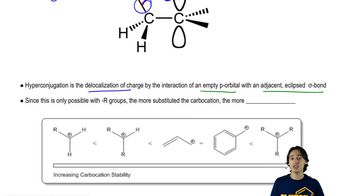
Carbocation stability is a crucial factor in determining the rate of electrophilic addition reactions. Alkenes typically form more stable carbocations than alkynes due to the presence of more substituents that can stabilize the positive charge. This increased stability leads to faster reaction rates for alkenes when reacting with electrophiles like HBr, compared to alkynes, which form less stable carbocations.
Steric and electronic effects play a significant role in the reactivity of alkenes and alkynes. The steric hindrance around the double or triple bond can affect how easily electrophiles approach and react with the substrate. Additionally, the electronic effects, such as the inductive effect from substituents, can influence the electron density at the reactive site, further affecting the reactivity of alkenes versus alkynes in reactions with different electrophiles like HBr and Br₂.