Ch. 5 - Genetics
Norman-McKay- Microbiology: Basic and Clinical Principles 2nd Edition
Norman-McKay2nd EditionMicrobiology: Basic and Clinical PrinciplesISBN: 9780137661619Not the one you use?Change textbook
Chapter 5, Problem 22

Protein synthesis occurs in two main stages: ___________ and ___________.

Verified step by step guidance
1
Identify the two main stages of protein synthesis, which are fundamental processes in molecular biology.
Recall that protein synthesis involves decoding genetic information to build proteins, starting with the creation of messenger RNA (mRNA) from DNA.
Recognize that the first stage is called transcription, where the DNA sequence is copied into mRNA.
Understand that the second stage is translation, where the mRNA sequence is used to assemble amino acids into a polypeptide chain (protein) at the ribosome.
Summarize that the two main stages of protein synthesis are transcription and translation.

Verified video answer for a similar problem:

This video solution was recommended by our tutors as helpful for the problem above.
Video duration:
2m
Was this helpful?

Key Concepts

Here are the essential concepts you must grasp in order to answer the question correctly.

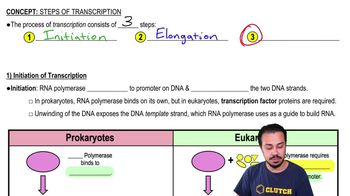
Transcription

Transcription is the first stage of protein synthesis where the DNA sequence of a gene is copied into messenger RNA (mRNA). This process occurs in the nucleus of eukaryotic cells and involves RNA polymerase binding to DNA to synthesize a complementary RNA strand.
Recommended video:
Guided course
04:16
Initiation of Transcription

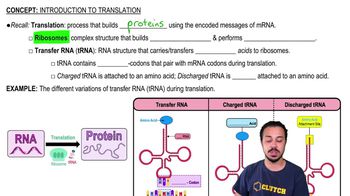
Translation

Translation is the second stage of protein synthesis where the mRNA sequence is decoded by ribosomes to assemble amino acids into a polypeptide chain. Transfer RNA (tRNA) molecules bring specific amino acids corresponding to codons on the mRNA, forming a protein.
Recommended video:
Guided course
06:12
Introduction to Translation

Role of mRNA and Ribosomes

mRNA serves as the template carrying genetic information from DNA to ribosomes, the cellular machinery that facilitates translation. Ribosomes read the mRNA codons and coordinate the addition of amino acids, ensuring accurate protein assembly.
Recommended video:
Guided course
01:51
Prokaryotic Ribosomes
Related Practice
Textbook Question

The following is a schematic of the parent DNA that is about to be repli­cated. Which side of the pictured DNA molecule (A or B) would be the leading side? Explain your answer.

1227
views
Textbook Question

In Griffith's classical experiments on transformation, which of the following scenarios led to a dead mouse? Select all that apply.

a. Infecting the mouse with a living strain of S. pneumoniae that makes a capsule

b. Infecting the mouse with a heat-killed strain of S. pneumoniae that makes a capsule

c. Infecting the mouse with a heat-killed strain of S. pneumoniae that makes a capsule and a living strain of S. pneumoniae that cannot make a capsule

d. Infecting the mouse with a living strain of S. pneumoniae that cannot make a capsule

1531
views
Textbook Question

Cells that can be transformed are said to be ___________.

1899
views
Textbook Question

Use the genetic code table in the chapter and the DNA sequence below to answer the following questions:

3'-TACATAAAATAATGGCGTTCTATT-5'

a. What would the mRNA sequence be, based on the provided DNA sequence?

b. What would the corresponding polypeptide sequence be for this DNA sequence?

c. What tRNA anticodon loop would correspond to the third codon of the mRNA?

d. What would the mRNA and polypeptide sequences be if the second adenine in the DNA was deleted?

1434
views
Textbook Question

Which of the following is produced by transcription?

a. mRNA

b. Protein

c. DNA

d. None of the above

1306
views
Textbook Question

Quorum sensing helps cells _______.

a. mutate

b. form biofilms

c. carry out transduction

d. copy their DNA

e. perform conjugation

1377
views