Indicate the true statements and then correct the false statements so that they are true. a. The Gram stain is a simple stain. b. Simple stains reveal information about size, shape, and arrangement. c. Bright field microscopy requires a stained sample. d. Dark field microscopy requires a stained sample. e. The acid-fast stain detects peptidoglycan in the cell walls of certain bacteria. f. Gram-positive bacteria have a thin peptidoglycan layer in the cell wall.
Verified step by step guidance
1
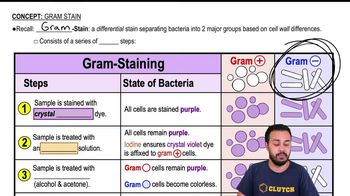
Step 1: Evaluate statement (a): "The Gram stain is a simple stain." Understand that a simple stain uses one dye to color cells, while the Gram stain is a differential stain that uses multiple reagents to distinguish bacteria based on cell wall properties. Determine if this statement is true or false, and if false, correct it by explaining the nature of the Gram stain.
Step 2: Evaluate statement (b): "Simple stains reveal information about size, shape, and arrangement." Recall that simple stains use a single dye to color cells uniformly, which helps visualize morphology and arrangement. Confirm if this statement is true or false, and if false, provide the correct explanation.
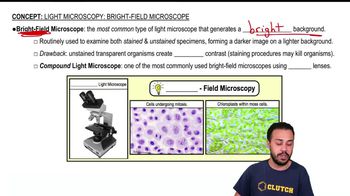
Step 3: Evaluate statement (c): "Bright field microscopy requires a stained sample." Consider that bright field microscopy often uses stained samples to increase contrast, but some samples can be observed unstained if they have natural contrast. Decide if the statement is true or false, and correct it if necessary.
Step 4: Evaluate statement (d): "Dark field microscopy requires a stained sample." Remember that dark field microscopy enhances contrast by scattering light and typically observes live, unstained samples. Determine the truth of this statement and correct it if false.
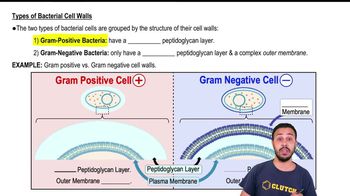
Step 5: Evaluate statements (e) and (f): For (e) "The acid-fast stain detects peptidoglycan in the cell walls of certain bacteria," recall that acid-fast staining targets mycolic acid in the cell walls, not peptidoglycan. For (f) "Gram-positive bacteria have a thin peptidoglycan layer," remember that Gram-positive bacteria have a thick peptidoglycan layer. Identify which are true or false and provide corrected versions.
Verified video answer for a similar problem:
This video solution was recommended by our tutors as helpful for the problem above.
Video duration:
2m
Play a video:
0 Comments
Key Concepts
Here are the essential concepts you must grasp in order to answer the question correctly.
Gram Stain Technique
The Gram stain is a differential staining method that classifies bacteria into Gram-positive or Gram-negative based on cell wall composition. It uses multiple dyes and reagents, unlike a simple stain, to reveal differences in peptidoglycan thickness and cell wall structure.
Bright field microscopy typically requires stained samples to increase contrast and visualize cells clearly, while dark field microscopy allows viewing of live, unstained specimens by illuminating them against a dark background, enhancing visibility without staining.
Gram-positive bacteria have a thick peptidoglycan layer, whereas Gram-negative bacteria have a thin layer. Acid-fast staining targets mycolic acid in certain bacterial cell walls, not peptidoglycan, helping identify acid-fast organisms like Mycobacterium species.

 2:25 minutes
 Verified step by step guidance
 04:57
04:57