Ch. 5 - Genetics
Norman-McKay- Microbiology: Basic and Clinical Principles 2nd Edition
Norman-McKay2nd EditionMicrobiology: Basic and Clinical PrinciplesISBN: 9780137661619Not the one you use?Change textbook
Chapter 5, Problem 2

Indicate the true statements and then correct the false statements so that they are true.
a. DNA is replicated in a 3' to 5' direction.
b. DNA has a parallel arrangement.
c. RNA primase is required on the leading and the lagging strand.
d. DNA ligase forms phosphodiester bonds between Okazaki fragments on the lagging strand.
e. Prokaryotic mRNA requires processing before it is translated.
f. In RNA, A bonds to U.
g. In DNA, C bonds with G.
h. RNA contains deoxyribonucleotides.

Verified step by step guidance
1
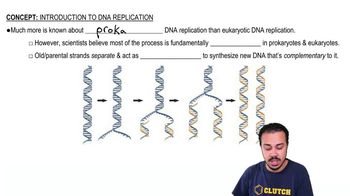
Step 1: Analyze statement (a): DNA replication occurs by adding nucleotides to the 3' end of the new strand, so the new strand is synthesized in the 5' to 3' direction. The template strand is read in the 3' to 5' direction. Therefore, the statement 'DNA is replicated in a 3' to 5' direction' is false. Correct it to: 'DNA is replicated in the 5' to 3' direction.'
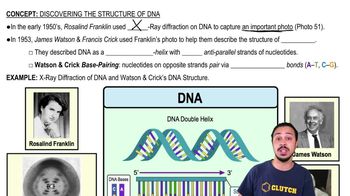
Step 2: Analyze statement (b): DNA strands in the double helix are antiparallel, meaning one strand runs 5' to 3' and the other runs 3' to 5'. The statement 'DNA has a parallel arrangement' is false. Correct it to: 'DNA has an antiparallel arrangement.'
Step 3: Analyze statement (c): RNA primase synthesizes RNA primers on both the leading and lagging strands to initiate DNA synthesis. This statement is true.
Step 4: Analyze statement (d): DNA ligase forms phosphodiester bonds between Okazaki fragments on the lagging strand to join them into a continuous strand. This statement is true.
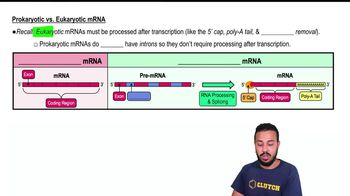
Step 5: Analyze statement (e): Prokaryotic mRNA is typically polycistronic and does not require extensive processing like eukaryotic mRNA (no splicing, 5' cap, or poly-A tail). Therefore, the statement 'Prokaryotic mRNA requires processing before it is translated' is false. Correct it to: 'Prokaryotic mRNA does not require processing before it is translated.'

Verified video answer for a similar problem:
This video solution was recommended by our tutors as helpful for the problem above.
Video duration:
4m
Was this helpful?

Key Concepts

Here are the essential concepts you must grasp in order to answer the question correctly.

DNA Replication Directionality

DNA strands have directionality, running from 5' to 3' ends. DNA polymerase synthesizes new DNA only in the 5' to 3' direction by adding nucleotides to the 3' end of the growing strand. The template strand is read in the 3' to 5' direction, but the new strand is built 5' to 3'.
Recommended video:
Guided course
03:37
Introduction to DNA Replication

Structure and Function of RNA Primase and DNA Ligase

RNA primase synthesizes short RNA primers needed to start DNA synthesis on both leading and lagging strands. DNA ligase seals gaps between Okazaki fragments on the lagging strand by forming phosphodiester bonds, ensuring a continuous DNA strand.
Recommended video:
Guided course
04:41
Discovering the Structure of DNA

Differences Between Prokaryotic and Eukaryotic mRNA and Base Pairing Rules

Prokaryotic mRNA is typically ready for translation immediately after transcription, lacking extensive processing seen in eukaryotes. Base pairing rules state that in RNA, adenine pairs with uracil (A-U), and in DNA, cytosine pairs with guanine (C-G). RNA contains ribonucleotides, not deoxyribonucleotides.
Recommended video:
Guided course
01:58
Prokaryotic vs. Eukaryotic mRNA