

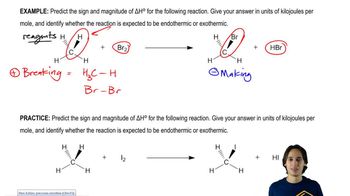
When ethene is treated in a calorimeter with H2 and a Pt catalyst, the heat of reaction is found to be –137 kJ/mol (–32.7 kcal/mol), and the reaction goes to completion. When the reaction takes place at 1400 K, the equilibrium is found to be evenly balanced, with Keq =1. Compute the value of ΔS for this reaction.
Verified step by step guidance
1
Step 1: Understand the problem. The reaction involves ethene (CH2=CH2) reacting with hydrogen (H2) in the presence of a platinum catalyst to form ethane (CH3—CH3). The heat of reaction (ΔH) is given as -137 kJ/mol, and at 1400 K, the equilibrium constant (Keq) is 1. We need to compute the entropy change (ΔS) for this reaction.
Step 2: Recall the relationship between Gibbs free energy (ΔG), enthalpy change (ΔH), and entropy change (ΔS). The equation is: , where T is the temperature in Kelvin.
Step 3: At equilibrium, the Gibbs free energy change (ΔG) is zero because Keq = 1. This simplifies the equation to: . Rearrange this equation to solve for ΔS: .
Step 4: Substitute the given values into the equation. ΔH is -137 kJ/mol, and T is 1400 K. Ensure that the units are consistent; ΔH should be converted to joules (1 kJ = 1000 J) if necessary.
Step 5: Perform the division to calculate ΔS. The result will be in units of J/(mol·K). This value represents the entropy change for the reaction under the given conditions.
Verified video answer for a similar problem:
This video solution was recommended by our tutors as helpful for the problem above
Video duration:
3m
Play a video:
0 Comments
Key Concepts
Here are the essential concepts you must grasp in order to answer the question correctly.
Enthalpy (ΔH)
Enthalpy is a thermodynamic property that represents the total heat content of a system. In this reaction, the negative value of ΔH (-137 kJ/mol) indicates that the reaction is exothermic, meaning it releases heat to the surroundings. Understanding enthalpy is crucial for analyzing energy changes during chemical reactions and helps predict the spontaneity of the reaction.
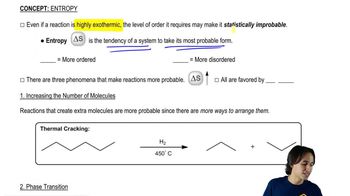
Entropy is a measure of the disorder or randomness in a system. It plays a key role in determining the spontaneity of a reaction alongside enthalpy. In this context, calculating ΔS will help assess how the reaction's disorder changes as ethene and hydrogen gas convert into ethane, particularly under the given conditions of temperature and equilibrium.
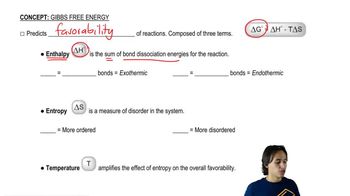
Gibbs Free Energy combines enthalpy and entropy to determine the spontaneity of a reaction at constant temperature and pressure. The relationship is given by the equation ΔG = ΔH - TΔS. Since the equilibrium constant (Keq) is 1 at 1400°K, ΔG is zero, indicating that the system is at equilibrium. This relationship is essential for calculating ΔS using the provided ΔH and temperature.