

Each of these four structures has molecular formula C4H8O2. Match the structure with its characteristic proton NMR signals. (Not all of the signals are listed in each case.) (a) sharp 1H singlet at δ8.0 and 2H triplet at δ4.0 (b) sharp 3H singlet at δ2.0 and 2H quartet at δ4.1 (c) sharp 3H singlet at δ3.7 and 2H quartet at δ2.3 (d) broad 1H singlet at δ11.5 and 2H triplet at δ2.3
Verified step by step guidance
1
Step 1: Analyze the molecular formula C4H8O2 and recognize that the structures provided are isomers. Each structure corresponds to a different functional group arrangement, which will influence the proton NMR signals.
Step 2: Examine structure (a). It contains a carboxylic acid group (-COOH), which typically produces a broad singlet around δ 11-12 ppm due to the acidic proton. The 2H triplet at δ 2.3 ppm corresponds to the CH2 group adjacent to the carbonyl group.
Step 3: Examine structure (b). It contains an ester functional group (-COOCH3). The sharp 3H singlet at δ 2.0 ppm corresponds to the methyl group directly attached to the oxygen atom. The 2H quartet at δ 4.1 ppm corresponds to the CH2 group adjacent to the oxygen atom.
Step 4: Examine structure (c). It contains an ester functional group (-COOCH2CH3). The sharp 3H singlet at δ 3.7 ppm corresponds to the methyl group attached to the oxygen atom. The 2H quartet at δ 2.3 ppm corresponds to the CH2 group adjacent to the carbonyl group.
Step 5: Examine structure (d). It contains a hydroxyl group (-OH) and a ketone group (-COCH3). The broad 1H singlet at δ 11.5 ppm corresponds to the hydroxyl proton. The 2H triplet at δ 2.3 ppm corresponds to the CH2 group adjacent to the ketone group.
Verified video answer for a similar problem:
This video solution was recommended by our tutors as helpful for the problem above
Video duration:
5m
Play a video:
Was this helpful?
Key Concepts
Here are the essential concepts you must grasp in order to answer the question correctly.
Proton NMR Spectroscopy
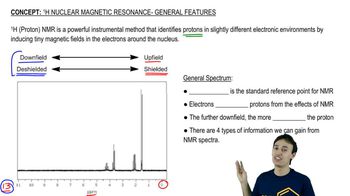
Proton Nuclear Magnetic Resonance (NMR) spectroscopy is a powerful analytical technique used to determine the structure of organic compounds. It provides information about the number of hydrogen atoms in different environments within a molecule, indicated by chemical shifts (δ) in parts per million (ppm). The splitting patterns (singlets, doublets, triplets) reveal the number of neighboring hydrogen atoms, which helps in deducing the molecular structure.
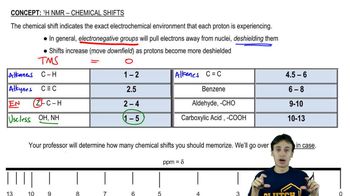
Chemical shifts in NMR spectroscopy refer to the resonant frequency of a nucleus relative to a standard in a magnetic field. They are influenced by the electronic environment surrounding the hydrogen atoms, with electronegative atoms or functional groups causing downfield shifts (higher δ values). Understanding chemical shifts is crucial for identifying functional groups and predicting the behavior of protons in different molecular environments.
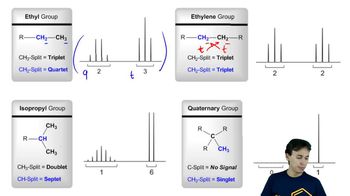
Splitting patterns in NMR arise from the interaction of non-equivalent neighboring hydrogen atoms, described by the n+1 rule, where n is the number of neighboring protons. This results in signals appearing as multiplets (singlets, doublets, triplets, etc.), providing insight into the connectivity and arrangement of atoms in a molecule. Recognizing these patterns is essential for interpreting NMR spectra and correlating them with specific molecular structures.