Identify the solute and the solvent in each solution composed of the following: a. 10.0 g of NaCl and 100.0 g of H2O
Verified step by step guidance
1
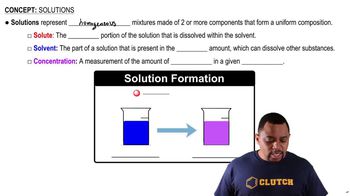
Step 1: Understand the definitions of solute and solvent. The solute is the substance that is dissolved, and the solvent is the substance that does the dissolving. Typically, the solvent is present in a larger amount compared to the solute.
Step 2: Examine the given quantities in the problem. You are provided with 10.0 g of NaCl and 100.0 g of H₂O.
Step 3: Compare the amounts of the two substances. Since 100.0 g of H₂O is greater than 10.0 g of NaCl, H₂O is the solvent, and NaCl is the solute.
Step 4: Recall that NaCl (sodium chloride) is a common ionic compound that dissolves in water to form a solution. This reinforces that NaCl is the solute and H₂O is the solvent.
Step 5: Conclude that in this solution, NaCl is the solute (the substance being dissolved), and H₂O is the solvent (the substance doing the dissolving).
Verified video answer for a similar problem:
This video solution was recommended by our tutors as helpful for the problem above
Video duration:
1m
Play a video:
Was this helpful?
Key Concepts
Here are the essential concepts you must grasp in order to answer the question correctly.
Solute
A solute is a substance that is dissolved in a solvent to form a solution. In the context of the given question, the solute is the component present in a lesser amount, which in this case is sodium chloride (NaCl). Solutes can be solids, liquids, or gases, and they disperse uniformly throughout the solvent.
A solvent is the substance that dissolves the solute, resulting in a solution. It is typically present in a greater amount compared to the solute. In the example provided, water (H₂O) acts as the solvent, facilitating the dissolution of NaCl and allowing for the formation of a homogeneous mixture.
A solution is a homogeneous mixture composed of two or more substances, where the solute is uniformly distributed within the solvent. Solutions can vary in concentration and can exist in different states of matter. Understanding the relationship between solute and solvent is crucial for analyzing the properties and behavior of solutions in various chemical contexts.