Determine each of the following for a 0.050 M KOH solution: a. [H3O+]
Verified step by step guidance
1
Step 1: Recognize that KOH is a strong base, meaning it completely dissociates in water. The concentration of OH⁻ ions in the solution will be equal to the concentration of KOH, which is 0.050 M.
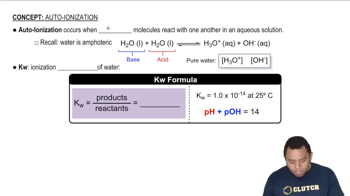
Step 2: Use the relationship between the concentrations of H₃O⁺ and OH⁻ in water, which is given by the ion-product constant for water:
Step 3: Rearrange the equation to solve for [H₃O⁺]: .
Step 4: Substitute the known values into the equation: .
Step 5: Perform the division to calculate [H₃O⁺]. This will give you the hydronium ion concentration in the solution.
Verified video answer for a similar problem:
This video solution was recommended by our tutors as helpful for the problem above
Video duration:
1m
Play a video:
Was this helpful?
Key Concepts
Here are the essential concepts you must grasp in order to answer the question correctly.
pH and pOH
pH is a measure of the acidity or basicity of a solution, defined as the negative logarithm of the hydronium ion concentration, [H₃O⁺]. pOH, on the other hand, measures the concentration of hydroxide ions, [OH⁻]. In a basic solution like KOH, pH and pOH are related through the equation pH + pOH = 14, which is essential for determining the [H₃O⁺] concentration.
Water undergoes autoionization, producing equal concentrations of H₃O⁺ and OH⁻ ions at equilibrium. The ion product constant for water (Kw) at 25°C is 1.0 x 10⁻¹⁴, which means that the product of [H₃O⁺] and [OH⁻] is always constant. This relationship is crucial for calculating the hydronium ion concentration in a KOH solution.
KOH is a strong base that completely dissociates in solution to produce K⁺ and OH⁻ ions. A 0.050 M KOH solution means that the concentration of OH⁻ ions is also 0.050 M. This concentration is used to find the [H₃O⁺] by applying the ion product constant of water, allowing for the determination of the solution's acidity.