Cholesterol and cholate are sterols with very similar structures. However, the roles they play in the body are different: Cholate is an emulsifier, whereas cholesterol plays an important role in membrane structure. Identify the small differences in their structures that make them well suited to their jobs in the body. Given their similar structures, can the roles of these molecules be reversed?
Verified step by step guidance
1
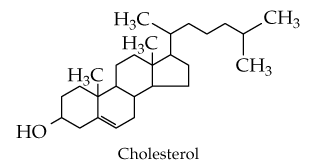
Examine the structure of cholesterol and cholate. Cholesterol is a sterol with a hydroxyl (-OH) group on its A-ring and a hydrophobic tail, making it largely nonpolar. Cholate, on the other hand, has additional polar functional groups, such as hydroxyl (-OH) and carboxylate (-COO⁻) groups, which make it amphipathic (both hydrophilic and hydrophobic).
Understand the role of cholesterol in the body. Cholesterol is primarily nonpolar, which allows it to integrate into the lipid bilayer of cell membranes. Its structure helps maintain membrane fluidity and stability, making it well-suited for this role.
Understand the role of cholate in the body. Cholate's amphipathic nature allows it to act as an emulsifier. The hydrophobic portion interacts with lipids, while the hydrophilic portion interacts with water, enabling the breakdown of fats into smaller droplets for digestion.
Compare the structural differences and their functional implications. Cholesterol's nonpolar structure makes it ideal for embedding in membranes, while cholate's polar and nonpolar regions make it effective at emulsifying fats. These structural differences are key to their distinct roles.
Conclude whether their roles can be reversed. Due to their structural differences, cholesterol cannot act as an emulsifier like cholate, and cholate cannot integrate into membranes like cholesterol. Their roles are specific to their structures and cannot be interchanged.
Verified video answer for a similar problem:
This video solution was recommended by our tutors as helpful for the problem above
Video duration:
4m
Play a video:
Was this helpful?
Key Concepts
Here are the essential concepts you must grasp in order to answer the question correctly.
Sterol Structure
Sterols, including cholesterol and cholate, have a characteristic multi-ring structure that is crucial for their biological functions. Cholesterol consists of a hydrophobic steroid nucleus with a hydroxyl group, making it amphipathic, which is essential for its role in membrane structure. Cholate, on the other hand, has additional functional groups that enhance its solubility in water, allowing it to act effectively as an emulsifier.
Cholesterol is vital for maintaining cell membrane integrity and fluidity. It fits between phospholipids in the membrane, preventing them from packing too closely together, which is essential for proper membrane function. This structural role is critical for various cellular processes, including signaling and transport.
Cholate serves as an emulsifier in the digestive system, facilitating the breakdown and absorption of dietary fats. Its structure allows it to interact with both lipids and water, forming micelles that help transport fats to be absorbed by intestinal cells. This unique function is largely due to its polar and non-polar regions, which differ from cholesterol's primary role in membrane structure.