Using wedge-and-dash bonds, draw a cis and a trans stereoisomers for each of the following compounds: (b) 1-bromo-2-ethylcyclopentane
Verified step by step guidance
1
Understand the structure of the compound: 1-bromo-2-ethylcyclopentane is a cyclopentane ring with a bromine atom attached to carbon-1 and an ethyl group attached to carbon-2. The stereoisomers arise because these substituents can be positioned differently in 3D space relative to the plane of the ring.
Recall the concept of cis and trans isomers: In cis isomers, the two substituents (bromine and ethyl group) are on the same side of the ring (both above or both below the plane). In trans isomers, the substituents are on opposite sides of the ring (one above and one below the plane).
Use wedge-and-dash notation to represent 3D structures: A wedge (solid triangle) indicates a bond coming out of the plane of the paper (toward the viewer), while a dash (dashed line) indicates a bond going into the plane of the paper (away from the viewer).
Draw the cis isomer: Place the bromine atom on carbon-1 and the ethyl group on carbon-2 both using wedges (or both using dashes) to indicate that they are on the same side of the cyclopentane ring.
Draw the trans isomer: Place the bromine atom on carbon-1 using a wedge and the ethyl group on carbon-2 using a dash (or vice versa) to indicate that they are on opposite sides of the cyclopentane ring.
Verified video answer for a similar problem:
This video solution was recommended by our tutors as helpful for the problem above
Video duration:
3m
Play a video:
Was this helpful?
Key Concepts
Here are the essential concepts you must grasp in order to answer the question correctly.
Stereoisomerism
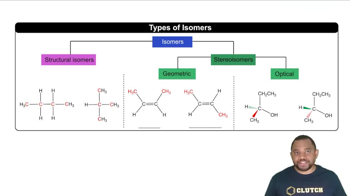
Stereoisomerism refers to the phenomenon where compounds have the same molecular formula and connectivity of atoms but differ in the spatial arrangement of those atoms. This can lead to different physical and chemical properties. The two main types of stereoisomers are geometric isomers (cis/trans) and optical isomers (enantiomers). Understanding stereoisomerism is crucial for drawing and distinguishing between different isomers.
Cis and trans isomers are specific types of geometric isomers that arise due to restricted rotation around a double bond or a ring structure. In cis isomers, substituents are on the same side of the double bond or ring, while in trans isomers, they are on opposite sides. This distinction is important in organic chemistry as it can significantly affect the physical properties and reactivity of the compounds.
Wedge-and-dash notation is a three-dimensional representation used in organic chemistry to depict the spatial arrangement of atoms in a molecule. Solid wedges indicate bonds that project out of the plane towards the viewer, while dashed lines represent bonds that extend behind the plane. This notation is essential for accurately illustrating stereochemistry, particularly when drawing cis and trans isomers, as it helps visualize the orientation of substituents.