Discuss the changes in the potential and kinetic energy of a roller-coaster ride as the roller-coaster car descends from the top of the ramp.
Verified step by step guidance
1
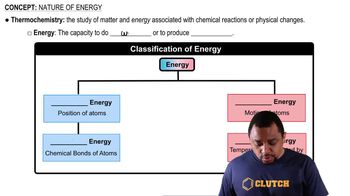
Understand the concept of potential energy: Potential energy is the energy stored in an object due to its position relative to a reference point. For the roller-coaster car at the top of the ramp, its potential energy is at its maximum because it is at the highest point.
Understand the concept of kinetic energy: Kinetic energy is the energy of motion. At the top of the ramp, the roller-coaster car has minimal kinetic energy because it is stationary or moving very slowly.
As the roller-coaster car begins to descend, its potential energy decreases: The height of the car decreases as it moves down the ramp, which reduces its potential energy. The formula for potential energy is , where is mass, is gravitational acceleration, and is height.
Simultaneously, the kinetic energy of the roller-coaster car increases: As the car descends, it gains speed, which increases its kinetic energy. The formula for kinetic energy is , where is mass and is velocity.
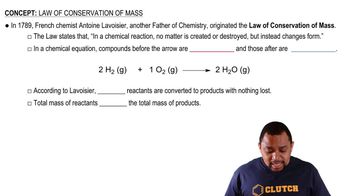
Recognize the energy transformation: The total mechanical energy (sum of potential and kinetic energy) remains constant if we neglect friction and air resistance. As the roller-coaster car descends, potential energy is converted into kinetic energy, demonstrating the principle of conservation of energy.
Verified video answer for a similar problem:
This video solution was recommended by our tutors as helpful for the problem above
Video duration:
4m
Play a video:
Was this helpful?
Key Concepts
Here are the essential concepts you must grasp in order to answer the question correctly.
Potential Energy
Potential energy is the energy stored in an object due to its position or height. In the context of a roller coaster, as the car is at the top of the ramp, it possesses maximum potential energy because of its elevated position. This energy is dependent on the height of the car and the gravitational force acting on it.
Kinetic energy is the energy of motion, which increases as an object moves faster. As the roller coaster car descends from the top of the ramp, its potential energy is converted into kinetic energy, causing the car to accelerate. The faster the car moves, the greater its kinetic energy becomes, illustrating the transformation of energy types during the ride.
The conservation of energy principle states that energy cannot be created or destroyed, only transformed from one form to another. In a roller coaster ride, the total mechanical energy (the sum of potential and kinetic energy) remains constant, assuming negligible friction. As the car descends, potential energy decreases while kinetic energy increases, demonstrating this fundamental principle of physics.